
A Rake's Progress: pl.2
1735
Medium
etching and engraving
Dimensions
sheet: 35.7 × 41.2 cm (14 1/16 × 16 1/4 in.)
Classification
Department
CG-E
Museum
National Gallery of Art, Washington, D.C.
Credit
Rosenwald Collection
Accession Number
1944.5.28
Rights
Public Domain
Art Historical Context
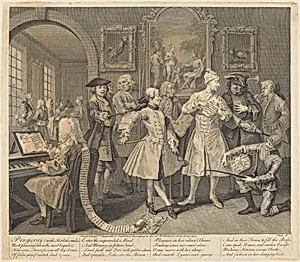
William Hogarth's *A Rake's Progress Plate 2* (1735) is the second installment in his famous series of eight satirical prints, chronicling the tragic downfall of the fictional Tom Rakewell, a young heir who squanders his fortune on vice and folly. Created during the early Georgian era in England, these works exemplify Hogarth's mastery of moralistic narrative art, blending sharp social commentary with vivid storytelling to warn against the perils of dissipation. As a pioneering figure in British art, Hogarth drew from the Rococo style but infused it with gritty realism, critiquing the excesses of London's fashionable elite. Rendered in etching and engraving on a modest sheet of 35.7 × 41.2 cm, this print allowed for detailed, reproducible imagery that reached a wide audience beyond oil paintings. Etching's fluid lines capture dynamic scenes, while engraving adds precise textures, making the series a revolutionary affordable art form—subscribed to by the public shortly after Hogarth painted the originals. Housed in the National Gallery of Art's Rosenwald Collection, Plate 2 likely depicts Rakewell's lavish morning levee, surrounded by flatterers, highlighting his rapid descent into superficial luxury. This work endures for its cultural bite, influencing later caricaturists and even inspiring operas like Stravinsky's. A timeless reminder of hubris, it invites visitors to ponder the consequences of unchecked indulgence.
About the Artist
William Hogarth · 1697–1764
William Hogarth (1697-1764) was an English painter, printmaker, and pictorial satirist who became the first great English-born artist to attract admiration abroad. Born into poverty in London, the son of a failed schoolmaster who was imprisoned for debt, Hogarth's early experiences with the harsh realities of 18th-century urban life profoundly shaped his artistic vision. After apprenticing with si...