
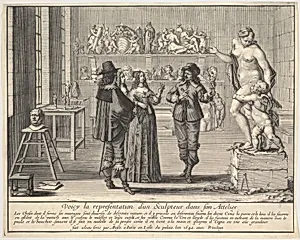
A Sculptor Presenting his Statue of Venus and Cupid
1642
Medium
Etching
Dimensions
Sheet (trimmed): 10 1/4 × 12 15/16 in. (26.1 × 32.9 cm)
Classification
Prints
Department
Drawings and Prints
Museum
Metropolitan Museum of Art, New York, NY
Credit
Bequest of Phyllis Massar, 2011
Accession Number
2012.136.18
Rights
Public Domain
Tags
Art Historical Context
In 1642, French artist Abraham Bosse created *A Sculptor Presenting his of Venus and Cupid a delicate etching that captures a pivotal moment in the artist's workshop. Bosse, a master of medium and a key figure in 17th-century printmaking, produced this work during the Baroque era, when detailed reproductive prints like this one bridged painting, sculpture, and everyday life. Measuring about 10 by 13 inches, the trimmed sheet exemplifies etching's precision—acid biting into a metal plate to yield fine lines and textures that mimic sculpture's depth. The scene shows a sculptor proudly unveiling his marble statue of the mythological lovers Venus and Cupid to an attentive audience of men and women, highlighting the patronage system that fueled Renaissance and Baroque art. Venus, goddess of love, and her son Cupid symbolize beauty and desire, themes central to classical revival in French art. Bosse's intricate technique—renowned through his own treatises on etching—brings the figures to life, with soft shadows and expressive gestures evoking the bustling ateliers of Paris. Housed in the Metropolitan Museum of Art's Drawings and Prints department (Bequest of Phyllis Massar, 2011), this print offers a window into the collaborative world of 17th-century creators, blending myth with the human drama of artistic ambition. It's a testament to Bosse's skill in making elite subjects accessible through affordable prints.
About the Artist
Abraham Bosse · 1602–1676
Abraham Bosse (1604–1676) was a French printmaker and theorist whose approximately 1,600 etchings provide an unparalleled visual record of 17th-century French life. Born to Huguenot parents in Tours, he trained in Paris under Melchior Tavernier and became a devoted follower of Jacques Callot's technical innovations. Bosse's meticulous etchings depicted subjects ranging from daily life and fashion ...