
A Sea Beach
Medium
Mezzotint; proof before published state
Dimensions
Image: 5 5/8 × 8 11/16 in. (14.3 × 22.1 cm) Plate: 7 7/16 × 9 15/16 in. (18.9 × 25.2 cm) Sheet: 10 9/16 × 12 1/4 in. (26.8 × 31.1 cm)
Classification
Prints
Department
Drawings and Prints
Museum
Metropolitan Museum of Art, New York, NY
Credit
The Elisha Whittelsey Collection, The Elisha Whittelsey Fund, 1954
Accession Number
54.539.5
Rights
Public Domain
Tags
Art Historical Context
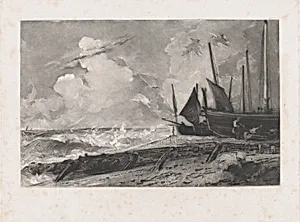
In the serene yet dramatic *A Sea Beach* (1830), printmaker David Lucas masterfully translates a composition by the renowned English Romantic painter John Constable into a mezzotint proof. This early impression, captured before the final published state, depicts a windswept seascape with boats dotting the waves, evoking Constable's deep affinity for the natural drama of Britain's coastline. Constable, celebrated for his luminous skies and truthful renderings of light and atmosphere, drew from his native Suffolk beaches, infusing the scene with a sense of untamed beauty and fleeting weather. Mezzotint, Lucas's chosen technique, revolutionized printmaking with its rich tonal gradations—from deep velvety blacks to soft highlights—mimicking the effects of oil paint. This collaboration, part of the groundbreaking *English Landscapes* series (1830–32), aimed to make Constable's innovative landscapes accessible beyond elite collectors, bridging painting and print traditions. As a proof, it offers a rare glimpse into the artistic process, showcasing subtle adjustments before mass production. Housed in The Metropolitan Museum of Art's Elisha Whittelsey Collection, this work highlights the 19th-century fusion of art and technology, preserving Constable's legacy as a pioneer of naturalistic outdoor painting for generations of visitors.
About the Artist
David Lucas|John Constable · 1802–1881
**David Lucas (1802–1881)** David Lucas was born in 1802 in Geddington Chase, Northamptonshire, the son of a farmer.) A chance encounter in 1820 led him to become a pupil of the renowned engraver Samuel William Reynolds, under whom he apprenticed in London until 1827, mastering the art of mezzotint engraving.) By 1827, Lucas had published his first mezzotints, showcasing his precocious talent for...