
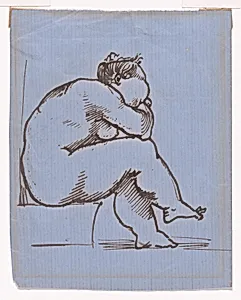
A Seated Fat Lady
ca. 1866
Medium
Pen and ink on lined blue paper
Dimensions
Sheet: 4 5/8 × 3 3/4 in. (11.8 × 9.5 cm)
Classification
Drawings
Department
Drawings and Prints
Museum
Metropolitan Museum of Art, New York, NY
Credit
Gift of Jacqueline Loewe Fowler, 2020
Accession Number
2021.16.4
Rights
Public Domain
Tags
Art Historical Context
Sir Edward Burne-Jones, a leading figure in the Pre-Raphaelite and Aesthetic movements, created *A Seated Fat Lady* around 1866, during his early career when he was deeply influenced by the medievalism and dreamlike idealism of artists like Dante Gabriel Rossetti. This intimate pen-and-ink drawing on lined blue paper captures a voluptuous female nude in a relaxed, seated pose, reflecting the Victorian fascination with the female form as both sensual and symbolic. At just 4 5/8 × 3 3/4 inches, it feels like a personal sketch, possibly from a notebook, highlighting Burne-Jones's skill in rendering soft contours and fluid lines amid everyday paper. The work's medium—delicate ink strokes on humble blue lined paper—underscores Burne-Jones's experimental approach to drawing as a standalone art form, blending precision with whimsy. Unlike his grand paintings of ethereal beauties, this piece celebrates a fuller figure, challenging slender ideals and evoking classical fertility goddesses or Renaissance studies. Its acquisition by the Metropolitan Museum of Art in 2020 as a gift preserves a rare glimpse into the artist's private process. Today, *A Seated Fat Lady* invites visitors to appreciate Burne-Jones's mastery of human anatomy and his playful subversion of beauty standards, a testament to the Pre-Raphaelite legacy of beauty in all forms.
About the Artist
Sir Edward Burne-Jones · 1833–1898
Edward Coley Burne-Jones was born on 28 August 1833 in Birmingham, the son of a frame-maker, and lost his mother within a week of his birth. He attended King Edward VI Grammar School and the Birmingham School of Art before proceeding to Exeter College, Oxford, in 1852, intending to study theology. At Oxford he formed a lifelong friendship with William Morris, and the two young men became intoxicat...