Ctrl K
1833–1898
Edward Coley Burne-Jones was born on 28 August 1833 in Birmingham, the son of a frame-maker, and lost his mother within a week of his birth. He attended King Edward VI Grammar School and the Birmingham School of Art before proceeding to Exeter College, Oxford, in 1852, intending to study theology. At Oxford he formed a lifelong friendship with William Morris, and the two young men became intoxicated by medieval art, literature, and Arthurian legend. A meeting with the painter Dante Gabriel Rossetti in 1856 proved decisive: Rossetti persuaded Burne-Jones to abandon his clerical plans and devote himself entirely to art. Burne-Jones left Oxford without a degree and entered Rossetti's circle, where he received his foundational artistic formation.
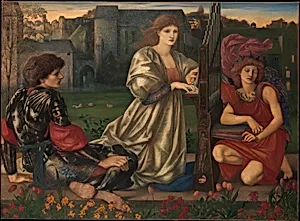
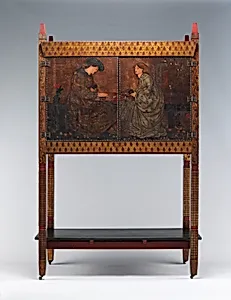
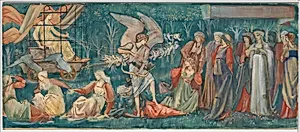
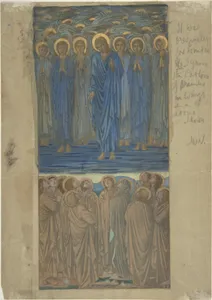
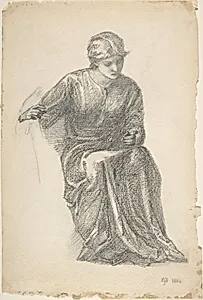
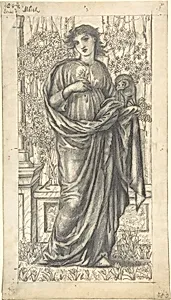
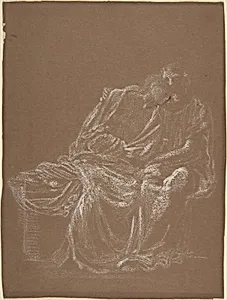
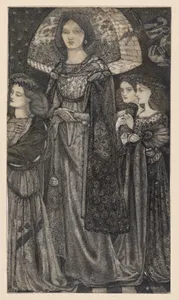
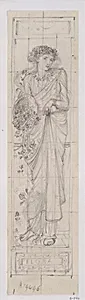
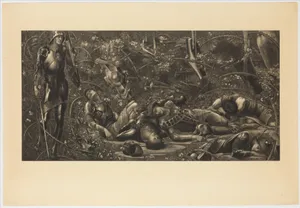
Though deeply shaped by Rossetti's Pre-Raphaelite principles — fidelity to nature, rich colour, subjects drawn from myth, legend, and poetry — Burne-Jones gradually developed a distinctive personal style. By the 1870s his figures had grown more elongated and dreamlike, inhabiting spaces of great decorative richness. His 1877 debut at the Grosvenor Gallery, which included The Beguiling of Merlin (1874), established him as a leading figure in the Aesthetic Movement. Major canvases followed: The Golden Stairs (1880), King Cophetua and the Beggar Maid (1884), and the monumental The Last Sleep of Arthur in Avalon, on which he worked from 1881 until his death. He also created the multi-panel series The Legend of Briar Rose, now considered among the finest Victorian narrative paintings. In parallel, he designed stained glass windows, tapestries, jewellery, tiles, and book illustrations for Morris & Co., contributing to some of the finest decorative schemes of the era. His stained glass may be seen in Christ Church Oxford, St Philip's Cathedral Birmingham, and Trinity Church Boston, among many others.
Burne-Jones received a baronetcy in 1894 — an honour he accepted reluctantly. He died on 17 June 1898. Though his reputation was eclipsed by Modernism in the early twentieth century, a major reassessment from the mid-1970s onward restored his standing as one of the greatest artists of the Victorian age. His influence extended to French Symbolism and beyond, and the Birmingham Museum and Art Gallery holds the world's largest collection of his work.