
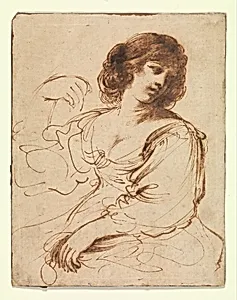
A Seated Young Woman Looking Over Her Shoulder
early–mid-17th century
Medium
Pen and brown ink
Dimensions
7 9/16 x 5 15/16 in. (19.2 x 15.1 cm)
Classification
Drawings
Department
Robert Lehman Collection
Museum
Metropolitan Museum of Art, New York, NY
Credit
Robert Lehman Collection, 1975
Accession Number
1975.1.368
Rights
Public Domain
Tags
Art Historical Context
In the Robert Lehman Collection at The Metropolitan Museum of Art,A Seated Young Woman Looking Her Shoulder* showcases the masterful pen and brown ink technique of Guercino ( Francesco Barbieri), a figure of the Bolognese Baroque school in the early to mid-17th century This intimate drawing, measuring just 7 9/16 x 5 15/16 inches, captures a moment of graceful introspection: a young woman seated and glancing back with a subtle twist of her torso, her flowing drapery rendered with fluid, expressive lines. Guercino, whose nickname means "the squinter" due to a visual impairment, was renowned for his dynamic compositions and dramatic chiaroscuro effects, even in preparatory sketches like this one. Created during the height of the Baroque era, when artists favored emotional intensity and naturalism over Renaissance idealization, the work likely served as a study for a painting or fresco, highlighting Guercino's skill in conveying movement and humanity through economical strokes of ink. Pen and brown ink was a favored medium for Italian draughtsmen of the period, allowing for rapid yet precise modeling of form and shadow. This piece exemplifies Guercino's ability to infuse everyday subjects—here, a poised female figure—with poetic vitality, making it a gem for admirers of 17th-century drawing traditions.
About the Artist
Guercino (Giovanni Francesco Barbieri) · 1591–1666
Guercino — the nickname meaning "squint-eyed" — was born Giovanni Francesco Barbieri in Cento, near Ferrara, in 1591. Largely self-taught in his early years, he absorbed the dramatic chiaroscuro of Ludovico Carracci's work in Bologna and the naturalistic innovations spreading from Caravaggio's circle, forging from these influences a highly personal style of extraordinary expressive power. By his e...