
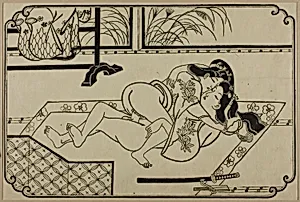
A sheet from a shunga album
1680s
Medium
Woodblock print; sumizuri-e
Classification
woodblock print
Department
Arts of Asia
Museum
Art Institute of Chicago
Accession Number
130219
Rights
Public Domain
Art Historical Context
Hishikawa Moronobu *A Sheet from a Shunga Album* (1680s) is a captivating example of early Japanese woodblock printing from the Art Institute of Chicago's Arts of collection. As one of the pioneering masters of ukiyo-e "pictures of the floating world"—onobu helped popularize this vibrant genre during Japan's Edo period. This sumizuri-e, a sophisticated single-color technique using black ink on paper showcases his skill in capturing intimate, erotic scenes with fluid lines and dynamic composition, predating the full-color nishiki-e prints that would later define the style. Shunga, or "spring pictures," were privately produced albums like this one, blending sensuality with humor and everyday life. Far from scandalous, they held cultural significance as aids to marital harmony, good-luck charms, or simply playful diversions for all classes, from merchants to samurai. Moronobu's work stands out for its realism and narrative flair, often depicting lovers in tender or passionate embraces amid luxurious settings. This sheet highlights the technical innovation of woodblock printing, where intricate carvings on wooden blocks allowed mass production while retaining artistic finesse. A testament to 17th-century Japan's artistic boldness, it invites visitors to appreciate the fusion of eroticism, craftsmanship, and social commentary in ukiyo-e's formative years.
About the Artist
Hishikawa Moronobu
Hishikawa Moronobu (1618–1694) holds an unassailable position in Japanese art history as the founder of ukiyo-e, the 'pictures of the floating world' that would become Japan's most internationally recognized art form. Born in the provincial town of Yasuda during the early Edo period, Moronobu transformed woodblock printing from a purely utilitarian craft into an independent artistic medium, establ...