
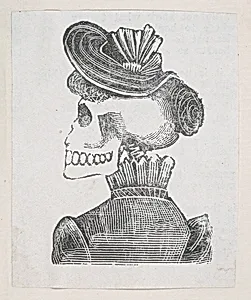
A skeleton with her back turned wearing a coat and hat, from a broaside entitled 'La Calavera de Cupido', published by Antonio Vanegas Arroyo.
ca. 1880–1910
Medium
Type-metal engraving (reproduction?)
Dimensions
Sheet: 2 13/16 × 2 3/8 in. (7.2 × 6 cm)
Classification
Prints
Department
Drawings and Prints
Museum
Metropolitan Museum of Art, New York, NY
Credit
Gift of Jean Charlot, 1930
Accession Number
30.82.45
Rights
Public Domain
Tags
Art Historical Context
José Guadalupe Posada (1852–1913), a pioneering Mexican printmaker, created this striking image as part of the broadside *La Calavera de Cup* ("The Skull of Cupid"), by Antonio Vanegas Arroyo around 1880–1910. Posada's workshop in Mexico City produced affordable street broadsides—inexpensive sheets blending text and imagery for the masses—often featuring his signature *calaveras*, or skeletal figures. These prints satirized society during the Porfiriato, a time of political repression and social inequality, using death as an equalizer to mock the living. In this tiny type-metal engraving (7.2 × 6 cm), a skeleton stands with her back turned, dressed in a coat and hat, evoking a fashionable figure oblivious to mortality. The "Cupid" reference cleverly subverts romantic love, portraying death as the ultimate seducer. Posada's bold black-line technique, rooted in 19th-century relief printing, allowed mass reproduction on zinc or metal plates, making his macabre wit accessible to everyday Mexicans. This work exemplifies Posada's enduring influence on Mexican folk art and Día de los Muertos traditions, later inspiring artists like Diego Rivera. Donated to the Metropolitan Museum of Art in 1930, it captures the playful yet profound cultural role of skeletons in Latin American iconography, reminding us that death dances with us all.
About the Artist
José Guadalupe Posada · 1852–1913
José Guadalupe Posada (1852-1913) was a Mexican printmaker and engraver who revolutionized popular art and created some of the most iconic images in Mexican culture. Working primarily with publisher Antonio Vanegas Arroyo, he produced over 20,000 images during his career—inexpensive broadsheets sold for a penny on colored paper that made his art accessible to even the poorest workers. He transform...