
A Skeri Girl
1912
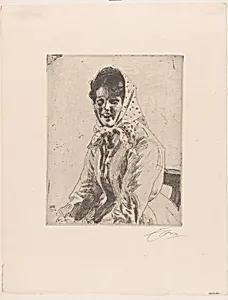
Medium
Etching; second state of two
Dimensions
Plate: 9 13/16 × 7 13/16 in. (25 × 19.8 cm) Sheet: 16 9/16 × 12 13/16 in. (42.1 × 32.6 cm)
Classification
Prints
Department
Drawings and Prints
Museum
Metropolitan Museum of Art, New York, NY
Credit
Harris Brisbane Dick Fund, 1917
Accession Number
17.3.717
Rights
Public Domain
Tags
Art Historical Context
Anders Zorn's *A Skeri Girl* (1912) is a captivating etching that exemplifies the Swedish master's prowess in printmaking. Zorn (1860–1920), renowned for his luminous portraits and nudes influenced by Impressionism and Realism, captured everyday subjects with remarkable sensitivity. This intimate portrait of a young girl Skeri—likely a Swedish locale—highlights his fascination with the human form and natural light, rendered in the second state of two, where the artist refined details for greater depth and texture. Etching, Zorn's preferred medium for its precision and tonal range, allowed him to achieve velvety blacks and subtle gradations using aquatint techniques. The plate measures 9 13/16 × 7 13/16 inches, with the full sheet even larger, emphasizing the work's scale on paper. As part of the Metropolitan Museum of Art's Drawings and Prints collection, acquired via the Harris Brisbane Dick Fund in 1917, it reflects early 20th-century appreciation for Zorn's international acclaim—he was a favorite of American collectors. This piece invites viewers to ponder the innocence of youth amid Sweden's folk traditions, showcasing Zorn's ability to elevate simple subjects into timeless art. A gem for print enthusiasts, it reveals the evolution of an image through its states, bridging personal expression and technical innovation.
About the Artist
Anders Zorn · 1860–1920
Anders Zorn (1860–1920), one of Sweden's most celebrated artists, was born on February 18 in Utmeland near Mora in Dalarna, and raised on his maternal grandparents' farm in the nearby hamlet of Yvraden. Displaying prodigious talent from a young age, he attended school in Mora Strand until age twelve, followed by secondary grammar school in Enköping, where he excelled in drawing people and horses. ...