
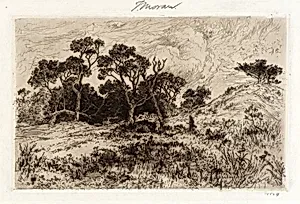
A Southerly Wind
ca. 1880-1890
Medium
Graphic Arts-Print
Classification
Graphic Arts-Print
Department
Smithsonian Collection
Museum
Smithsonian American Art Museum
Credit
Smithsonian American Art Museum, Transfer from the National Museum of American History, Division of Graphic Arts, Smithsonian Institution
Accession Number
1973.122.72
Rights
Public Domain
Tags
Art Historical Context
Thomas Moran's *A Southerly Wind*ca. 1880-1890) is a captivating graphic arts print that exemplifies the artist's mastery of atmospheric landscapes. a leading figure in the Hudson River School, Moran renowned for his luminous depictions of the American wilderness, often evoking the sublime power of nature. This work, housed in the Smithsonian American Art, likely captures the dynamic force of wind sweeping through a natural scene, a theme hinted at by its evocative title and tag. Printed during the Gilded Age, when Moran was at the height of his career—fresh from his iconic Yellowstone expeditions—this piece reflects the era's growing fascination with America's untamed frontiers. Prints like this one democratized art, making Moran's dramatic vistas accessible beyond oil paintings. His technique in graphic arts emphasized texture and movement, using etching or similar methods to convey wind's invisible energy through swirling lines and subtle tonal shifts. Transferred from the National Museum of American History, *A Southerly Wind* underscores Moran's enduring influence on American environmental art, bridging Romanticism with the conservation movement. Visitors will appreciate its whisper of nature's breath, inviting reflection on the winds that shaped our national identity.
About the Artist
Thomas Moran · 1837–1926
Thomas Moran (1837–1926) was an American painter and printmaker of the Hudson River School whose dramatic paintings of the American West played a pivotal role in the creation of the national parks. Born in Bolton, Lancashire, England, he emigrated with his family to Philadelphia as a child. He was largely self-taught, though he apprenticed briefly with a wood engraver and studied the work of J.M.W...