
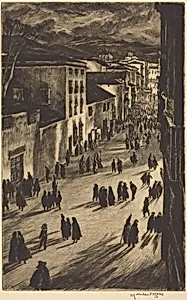
A Spanish Good Friday, Ronda
1925
Medium
drypoint in black
Dimensions
plate: 31.7 x 20.5 cm (12 1/2 x 8 1/16 in.) sheet: 45.6 x 27.7 cm (17 15/16 x 10 7/8 in.)
Classification
Department
CG-W
Museum
National Gallery of Art, Washington, D.C.
Credit
Gift of Miss Elisabeth Achelis
Accession Number
1942.6.20
Rights
Public Domain
Art Historical Context
Muirhead Bone's *A Spanish Good Friday,onda* (1925) captures the solemn drama of Holy Week processions in the rugged Andalusian town ofonda, Spain. Renowned Scottish artist and printmaker Bone, a master of architectural detail and atmospheric scenes, traveled extensively in Europe, drawing inspiration from historic sites and cultural rituals. This drypoint etching evokes the intensity of Good Friday observances, where hooded penit and ornate religious statues parade through narrow streets beneath Ronda's dramatic cliffs and famed Puente Nuevo bridge, blending faith, tradition, and landscape in a timeless tableau. Bone's chosen medium, drypoint in black ink, exemplifies early 20th-century printmaking's etching revival. By scratching directly into a copper plate, he created velvety, textured lines from the burr—a fragile effect yielding only small editions before the plate wore smooth. Measuring 31.7 x 20.5 cm on the plate, this intimate work showcases his precision in rendering stone textures, flickering torchlight, and crowded figures, inviting viewers into the scene's hushed reverence. Now in the National Gallery of Art as a gift from Miss Elisabeth Achelis, the print highlights Bone's legacy as a bridge between traditional topographical art and modernist sensibilities, preserving a vivid snapshot of Spanish Catholic devotion amid interwar wanderlust. A poignant reminder of cultural heritage, it draws us into Ronda's sacred spectacle.
About the Artist
Muirhead Bone · 1876–1953
Sir Muirhead Bone was born in Glasgow on March 23, 1876, into a world of shipyards and industrial architecture that would profoundly shape his art. He trained initially in architectural draftsmanship before studying at Glasgow School of Art, developing a draughtsman's eye for structure and mass. He began printmaking in 1898, and though his first known print was a lithograph, he became celebrated a...