
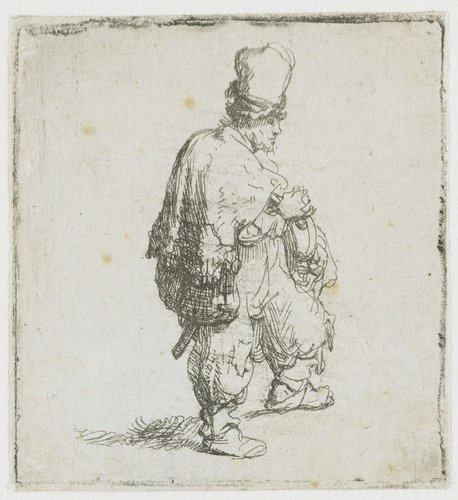
A standing hurdy-gurdy player
c. 1631
Medium
etching
Dimensions
52; 48
Rights
Public Domain
About this artwork
height 52 mm x width 48 mm
Art Historical Context
In the early 1630s, van Rijn, the Dutch Baroque master, captured the humble figure of a standing hurdy-gurdy in this intimate etching, dated around 1631. Measuring just 52 mm high by 48 mm wide, the work exemplifies Rembrandt's fascination with everyday street life during his formative years in Leiden and Amsterdam The hurdy-gurdy, a stringed instrument cranked to produce drone-like music, evokes the itinerant musicians of 17th-century Europe, marginalized figures whose presence added vibrancy to urban scenes. Rembrandt's etching technique shines here, with fine lines and subtle cross-hatching creating depth and texture on such a minuscule scale. As a pioneer in printmaking, he blended etching with drypoint for velvety burrs and rich tonal contrasts, allowing this tiny plate to convey the player's weathered expression and flowing garments with remarkable lifelike quality. This innovation made his prints accessible to a wider audience beyond oil paintings. Culturally, the piece reflects the Dutch Golden Age's interest in genre scenes, humanizing the lower classes amid economic prosperity. One of over 300 etchings Rembrandt produced, it highlights his versatility and enduring appeal, inviting viewers to ponder the stories behind the music.
About the Artist
Rembrandt van Rijn · 1606–1669
Rembrandt Harmenszoon van Rijn (1606–1669) stands as one of the greatest visual artists in the history of Western art and the most important Dutch painter of the 17th century. Born in Leiden to a prosperous miller's family, Rembrandt transformed painting through his revolutionary use of light and shadow, his psychological depth in portraiture, and his elevation of etching to a fine art. His approx...