
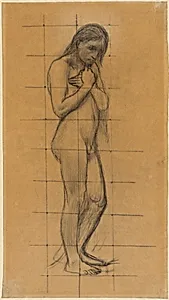
A Standing Male Nude
c. 1879
Medium
black chalk with stumping on tracing paper, squared for transfer
Dimensions
sheet: 35.2 × 19.9 cm (13 7/8 × 7 13/16 in.)
Classification
Drawing
Department
CG-E
Museum
National Gallery of Art, Washington, D.C.
Credit
Ailsa Mellon Bruce Fund
Accession Number
2015.56.2
Rights
Public Domain
Art Historical Context
Pierre Puvis de Chavannes, a leading French Symbolist painter of the late 19th century, created *A Standing Male Nude* around 1879 as a preparatory drawing. Known for his monumental murals adorning public spaces like the Panthéon and Sorbonne, Puvis drew inspiration from classical antiquity, blending idealized human forms with dreamlike, poetic atmospheres. This work exemplifies his academic rigor, capturing the male figure in a poised, contrapposto stance that echoes Renaissance masters like Michelangelo, while foreshadowing Symbolist tendencies toward timeless, allegorical beauty. Executed in black chalk with stumping—a technique of smudging the medium with a stump or finger to achieve soft, graduated tones—on tracing paper, the drawing measures a modest 35.2 × 19.9 cm. The faint squaring grid reveals its practical purpose: transferring the refined pose to a larger canvas or mural. Tracing paper allowed Puvis to refine outlines precisely, a common 19th-century studio method that bridged draftsmanship and grand-scale execution. Housed in the National Gallery of Art through the Ailsa Mellon Bruce Fund, this study highlights Puvis's technical mastery and his role in revitalizing mural painting amid France's Third Republic. It invites visitors to appreciate the quiet intensity behind his ethereal public works, where anatomy meets idealism in a nod to enduring classical traditions.
About the Artist
Pierre Puvis de Chavannes · 1824–1898
Pierre Puvis de Chavannes (1824–1898) was a French painter who became the foremost muralist of nineteenth-century France and a crucial bridge between academic tradition and modernism. Born in Lyon to a prosperous family, he studied briefly with Henri Scheffer and Thomas Couture in Paris and traveled to Italy, where the frescoes of the Italian Renaissance made a lasting impression on his artistic v...