
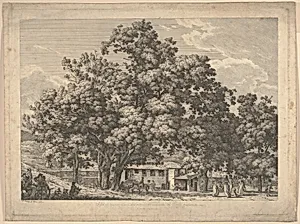
A Tavern at Monte Testaccio
Medium
Etching
Classification
Prints
Department
Drawings and Prints
Museum
Metropolitan Museum of Art, New York, NY
Credit
Gift of Mrs. John H. Sichel, 1966
Accession Number
66.747.67
Rights
Public Domain
Tags
Art Historical Context
Welcome to the Metropolitan Museum of Art's Drawings and Prints collection, where Jacob Wilhelm Mechau's *A Tavern at Monte Testaccio (1793) captures a vivid slice of Roman life. This etching by the German artist, known for his meticulous landscapes and architectural views during his travels in Italy, depicts a rustic nestled at the base of Monte Testaccio—an extraordinary ancient mound in Rome formed from millions of discarded amphorae shards dating back to the Roman Empire. Mechau's scene bustles with human figures, horses, trees, and sturdy architecture, evoking the everyday vibrancy of late 18th-century Italy amid this archaeological wonder. As an etching, the work showcases Mechau's mastery of the intaglio technique, where acid bites into a metal plate to create fine, intricate lines that reproduce the texture of foliage, stone, and fabric with remarkable precision. This printmaking method allowed artists like Mechau—active in the transition from Neoclassicism to Romanticism—to share detailed observations of picturesque sites far beyond their studios. Donated in 1966 by Mrs. John H. Sichel, the piece highlights how such prints preserved vanishing rural traditions and classical ruins for future generations, blending historical curiosity with artistic elegance.
About the Artist
Jacob Wilhelm Mechau · 1745–1808
Jacob Wilhelm Mechau (1745–1808) was a German painter and draughtsman who became one of the more distinctive landscape artists working in Rome during the late eighteenth century. Born in Dresden in 1745, Mechau received his early artistic education in the rich environment of that city's court culture, which placed a high premium on classical training and technical refinement. He later made his way...