
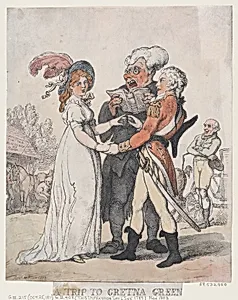
A Trip to Gretna Green
Medium
Hand-colored etching
Dimensions
Sheet: 11 11/16 × 9 1/8 in. (29.7 × 23.1 cm)
Classification
Prints
Department
Drawings and Prints
Museum
Metropolitan Museum of Art, New York, NY
Credit
The Elisha Whittelsey Collection, The Elisha Whittelsey Fund, 1959
Accession Number
59.533.900
Rights
Public Domain
Tags
Art Historical Context
In the lively world of early 19th-century British satire, Thomas Rowlandson's *A Trip to Gretna Green (1803), published by Rudolph Ackermann in London, captures the chaos and romance of elopement. This hand-colored etching, measuring 11 11/16 × 9 1/8 inches, depicts men and women in a whirlwind dash to Scotland's Gretna Green—a notorious border village where English couples could marry without parental consent, thanks to lax Scottish laws. Rowlandson's exaggerated caricatures poke fun at the frenzy of forbidden love, blending humor with social commentary on class, courtship, and rebellion. Rowlandson, a master of Regency-era caricature, was renowned for his witty, ink-and-wash drawings turned into affordable prints, often hand-colored for vivid appeal. Ackermann's innovative publishing house elevated such works, making satire accessible to a wide audience through techniques like etching, which allowed precise lines and rich tones. Produced amid England's strict marriage customs, this piece reflects cultural obsessions with weddings and youthful defiance, immortalizing a real phenomenon that drew thousands of runaways. Today, housed in the Metropolitan Museum of Art's Elisha Whittelsey Collection, it exemplifies the golden age of British graphic satire—sharp, colorful, and endlessly entertaining.
About the Artist
Thomas Rowlandson|Rudolph Ackermann, London · 1756–1827
Thomas Rowlandson (1757–1827) was an English artist and caricaturist whose satirical watercolors and prints captured the social life of Georgian Britain with unparalleled wit and technical mastery. Alongside James Gillray, he is recognized as one of the greatest British graphic artists, and his distinctive flowing line and keen observations have made his work integral to understanding late 18th an...