
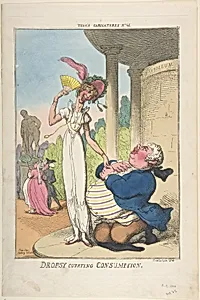
Dropsy Courting Consumption
October 25, 1810
Medium
Hand-colored etching
Dimensions
Plate: 13 11/16 x 9 11/16 in. (34.7 x 24.6 cm) Sheet: 15 5/8 x 10 7/16 in. (39.7 x 26.5 cm)
Classification
Prints
Department
Drawings and Prints
Museum
Metropolitan Museum of Art, New York, NY
Credit
The Elisha Whittelsey Collection, The Elisha Whittelsey Fund, 1959
Accession Number
59.533.1212
Rights
Public Domain
Tags
Art Historical Context
In the lively world of early 19th-century British satire, Thomas Rowlandson, a master caricaturist, created *Dropsy Courting Consumption* on October 25, 1810, published by Thomas Tegg. hand-colored etching (plate: 13 11/16 x 9 11/16 in.) captures Rowlandson's signature style: exaggerated, humorous figures skewering societal vices. Personifying Dropsy (edema, causing grotesque swelling) as a bloated suitor wooing Consumption (tuberculosis, the "wasting" disease), the print whimsically depicts illness as romantic rivals, likely mocking the era's quack remedies, hypochondria, and public fascination with ailments amid urban squalor. Rowlandson, influenced by William Hogarth, belonged to the golden age of English caricature, where prints like this—affordable and widely circulated—served as social commentary during the Regency period. Hand-coloring enhanced the etching's vividness, making the absurdity pop for tavern-goers and collectors alike, while critiquing how diseases ravaged the poor and fashionable alike. Housed in the Metropolitan Museum of Art's Drawings and Prints department (Elisha Whittelsey Collection, 1959), this work highlights printmaking's role in democratizing satire, blending dark humor with sharp observation to remind us of medicine's pre-scientific follies.
About the Artist
Thomas Rowlandson|Thomas Tegg · 1756–1827
Thomas Rowlandson (1757–1827) was an English artist and caricaturist whose satirical watercolors and prints captured the social life of Georgian Britain with unparalleled wit and technical mastery. Alongside James Gillray, he is recognized as one of the greatest British graphic artists, and his distinctive flowing line and keen observations have made his work integral to understanding late 18th an...