
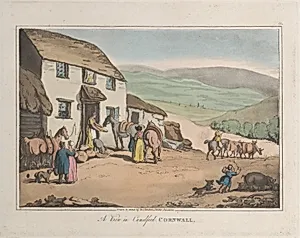
A View of Camelford, Cornwall
Medium
Hand-colored etching and aquatint
Dimensions
Plate: 7 3/8 × 9 3/8 in. (18.8 × 23.8 cm) Sheet: 7 11/16 × 9 3/4 in. (19.5 × 24.8 cm)
Classification
Prints
Department
Drawings and Prints
Museum
Metropolitan Museum of Art, New York, NY
Credit
The Elisha Whittelsey Collection, The Elisha Whittelsey Fund, 1959
Accession Number
59.533.1644(14)
Rights
Public Domain
Tags
Art Historical Context
Created in 1822, "A View of Camelford, Cornwall" captures a lively rural scene in this small Cornish market town. Thomas Rowlandson, renowned for his witty caricatures and lively drawings of Georgian life, collaborated here with aquatint engraver Joseph Constantine Stadler. Together they produced a hand-colored etching that blends topographical accuracy with Rowlandson’s characteristic charm, showing farm animals—cows, pigs, horses, and dogs—mingling near modest houses. The medium of hand-colored etching and aquatint was especially popular in the early nineteenth century for reproducing picturesque British views. Aquatint’s tonal washes allowed the print to mimic the soft effects of watercolor, making such works affordable alternatives to original paintings for a growing middle-class audience interested in travel and local scenery. Housed in the Metropolitan Museum of Art’s Department of Drawings and Prints, this sheet reflects the period’s fascination with documenting Britain’s regional landscapes just as industrialization began to transform the countryside. Its modest scale and warm coloring invite viewers to imagine daily life in a quiet Cornish community two centuries ago.
About the Artist
Thomas Rowlandson|Joseph Constantine Stadler · 1756–1827
Thomas Rowlandson (1757–1827) was an English artist and caricaturist whose satirical watercolors and prints captured the social life of Georgian Britain with unparalleled wit and technical mastery. Alongside James Gillray, he is recognized as one of the greatest British graphic artists, and his distinctive flowing line and keen observations have made his work integral to understanding late 18th an...