
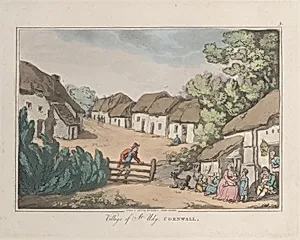
Village of St. Udy, Cornwall
Medium
Hand-colored etching and aquatint
Dimensions
Plate: 7 3/8 × 9 5/16 in. (18.7 × 23.6 cm) Sheet: 7 3/4 × 9 3/4 in. (19.7 × 24.7 cm)
Classification
Prints
Department
Drawings and Prints
Museum
Metropolitan Museum of Art, New York, NY
Credit
The Elisha Whittelsey Collection, The Elisha Whittelsey Fund, 1959
Accession Number
59.533.1644(9)
Rights
Public Domain
Tags
Art Historical Context
This charming hand-colored etching and aquatint captures the quiet rhythms of rural life in early nineteenth-century Cornwall. Created in 1822 by Thomas Rowlandson in collaboration with aquatint specialist Joseph Constantine Stadler, the print depicts the village of St. Udy (likely St Tudy) as a lively yet intimate community. Figures of men, women, and children mingle with dogs along winding lanes, evoking the everyday warmth of a Cornish settlement. Rowlandson, celebrated for his lively draftsmanship and keen eye for social observation, often turned his attention to British provincial scenes. The combination of etching for crisp lines and aquatint for soft tonal washes allowed the artists to suggest both architectural detail and atmospheric light, while delicate hand-coloring brought the scene to life for contemporary viewers. Such prints were popular souvenirs and educational images, helping city audiences imagine distant corners of Britain. Today, this work in the Metropolitan Museum’s collection offers a delightful window onto Regency-era village culture. Its modest scale and accessible medium remind us how prints helped shape public appreciation of regional landscapes and communities during a period of rapid social change.
About the Artist
Thomas Rowlandson|Joseph Constantine Stadler · 1756–1827
Thomas Rowlandson (1757–1827) was an English artist and caricaturist whose satirical watercolors and prints captured the social life of Georgian Britain with unparalleled wit and technical mastery. Alongside James Gillray, he is recognized as one of the greatest British graphic artists, and his distinctive flowing line and keen observations have made his work integral to understanding late 18th an...