
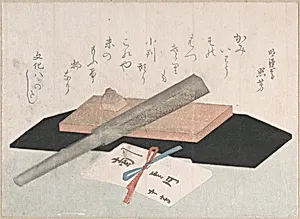
A Whetstone with a Razor, and an Envelope for a Present
Medium
Woodblock print (surimono); ink and color on paper
Dimensions
5 1/2 x 7 1/2 in. (14 x 19.1 cm)
Classification
Prints
Culture & Period
Japan · Edo period (1615–1868)
Department
Asian Art
Museum
Metropolitan Museum of Art, New York, NY
Credit
H. O. Havemeyer Collection, Bequest of Mrs. H. O. Havemeyer, 1929
Accession Number
JP2206
Rights
Public Domain
Tags
Art Historical Context
In the vibrant world of Edo-period Japan (1615–8), this delicate 1811 woodblock print, titled *A Whetstone with a Razor, and an Envelope a Present*, captures everyday objects with poetic elegance. Created by an unidentified artist, the surimono—a privately commissioned print often produced for special occasions like New Year's celebrations—features a whetstone alongside a razor and a decorative envelope, symbols perhaps evoking renewal, sharpness of mind, or gift-giving rituals. Measuring just 5½ x 7½ inches, its intimate scale invites close contemplation, typical of these luxury items made for elite patrons. Surimono stand out in Japanese print culture for their superior craftsmanship, employing intricate woodblock techniques with ink and vibrant colors on paper. Unlike mass-produced ukiyo-e, they often incorporated embossing, mica dusting, and calligraphy, showcasing the printer's artistry. This piece exemplifies the late Edo fascination with still-life compositions, transforming humble tools into emblems of refinement and transience. Housed in the Metropolitan Museum of Art's Asian Art Department as part of the H. O. Havemeyer Collection (1929), it reflects the global appreciation for Japan's "floating world" aesthetics. Visitors today can marvel at how such a modest scene bridges utility and beauty, a hallmark of Edo ingenuity.