
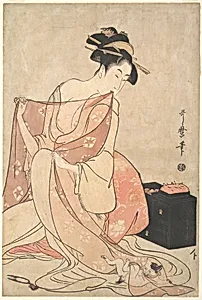
A Woman and a Cat
ca. 1793–94
Medium
One sheet of a triptych of woodblock prints; ink and color on paper
Dimensions
H. 15 1/8 in. (38.4 cm); W. 10 3/16 in. (25.9 cm)
Classification
Prints
Culture & Period
Japan · Edo period (1615–1868)
Department
Asian Art
Museum
Metropolitan Museum of Art, New York, NY
Credit
H. O. Havemeyer Collection, Bequest of Mrs. H. O. Havemeyer, 1929
Accession Number
JP1672
Tags
About this artwork
This woodblock print by Kitagawa Utamaro depicts a young woman seated before a lacquered needlework box, folding a length of resist-dyed fabric while a cat rests nearby. Created circa 1793-94 during the Edo period, the work exemplifies Utamaro's innovative approach to bijin-ga, or pictures of beautiful women. The print measures approximately 38.4 by 25.9 centimeters. Utamaro revolutionized the bijin-ga genre by removing traditional idealizing constraints and presenting beautiful women in contex...
Art Historical Context
Kitagawa Utamaro's *A Woman and a Cat* (ca. 1793–94) captures a serene moment of everyday life in Edo-period Japan (1615–1868). This woodblock print one sheet from a triptych in ink and color on paper shows a young woman seated before a lacquered needlework box, intently folding resist-dyed fabric as a cat lounges nearby. Measuring about 15⅛ × 10¼ inches, it exemplifies *bijin-ga*—pictures of beautiful women—from the vibrant ukiyo-e tradition of floating-world prints. Utamaro revolutionized the genre by portraying women in intimate domestic settings, free from the idealized poses of courtesan...
About the Artist
Kitagawa Utamaro · 1753–1806
Kitagawa Utamaro (c. 1753-1806) was one of the most celebrated masters of ukiyo-e woodblock printing, revolutionizing the art of bijin-ga (pictures of beautiful women) during Japan's Edo period. Born Kitagawa Ichitaro, his early life remains shrouded in mystery, with conflicting accounts placing his birth in Kyoto, Osaka, Yoshiwara in Edo (modern Tokyo), or Kawagoe in Musashi Province. Under the t...