
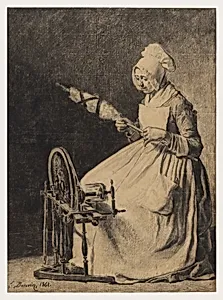
A Woman Spinning Flax
1861
Medium
Charcoal on laid paper
Dimensions
15 7/8 x 11 5/8 in. (40.3 x 29.6 cm)
Classification
Drawings
Department
Drawings and Prints
Museum
Metropolitan Museum of Art, New York, NY
Credit
Gift of Lila and Herman Shickman, 2000
Accession Number
2000.515
Rights
Public Domain
Tags
About this artwork
François Bonvin's "A Woman Spinning Flax" (1861) exemplifies the French Realist movement's dedication to depicting the lives of ordinary working people with dignity and truthfulness. Executed in charcoal on laid paper, this drawing showcases Bonvin's masterful handling of light and shadow, qualities that earned comparisons to 17th-century Dutch masters like Pieter de Hooch and Jean-Baptiste-Siméon Chardin. Born into poverty in Paris, Bonvin knew firsthand the struggles of the working class, havi...
Art Historical Context
François Bonvin's *A Woman Spinning Fl* (1861), a delicate charcoal drawing on laid paper, captures the quiet dignity of everyday labor in the French Realist tradition. Born into poverty in Paris and apprenticed as a child to a printer, Bonvin from personal experience to portray working-class life with unflin truthfulness, much like his contemporary Gustave Courbet. Here, a woman at her spinning wheel embodies the ancient craft of flax processing, elevated to the level of historical subjects through Bonvin's respectful gaze. Exhibiting at the 1850 Salon alongside Courbet, Bonvin rejected academic idealization, instead championing authenticity in art. Bonvin's self-taught mastery shines in his handling of light and shadow, evoking 17th-century Dutch masters like Pieter de Hooch and Jean-Baptiste-Siméon Chardin. Mentored by François-Marius Granet, he immersed himself in Flemish and Dutch painting, achieving a luminous atmosphere even in monochrome charcoal. Subtle tonal gradations and atmospheric depth highlight the woman's focused toil, measuring 15 7/8 x 11 5/8 inches. This work marks Bonvin at the peak of his career, before blindness curtailed his output in 1881. Generously opening his Atelier Flamand studio to artists like Henri Fantin-Latour and James McNeill Whistler, Bonvin fostered a community of Realists, making this drawing a testament to resilience and artistic solidarity. (218 words)
About the Artist
François Bonvin · 1817–1888
François Bonvin (1817–1887) was a French Realist painter whose quiet, meticulously observed canvases of domestic interiors and humble working-class subjects placed him among the most thoughtful and committed practitioners of the Realist movement in nineteenth-century France. Born in Vaugirard, on the outskirts of Paris, Bonvin came from modest origins and largely educated himself as an artist thro...