
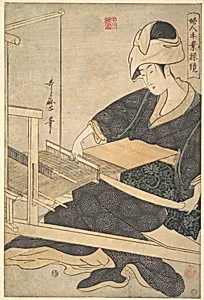
婦人手業操鏡|A Woman Weaving, Seated at a Hand Loom
ca. 1796
Medium
Woodblock print; ink and color on paper
Dimensions
14 3/4 x 9 7/8 in. (37.5 x 25.1 cm)
Classification
Prints
Culture & Period
Japan · Edo period (1615–1868)
Department
Asian Art
Museum
Metropolitan Museum of Art, New York, NY
Credit
Rogers Fund, 1914
Accession Number
JP152
Rights
Public Domain
Tags
Art Historical Context
In the vibrant world of Edo-period Japan (1615–1868), Kitagawa Utam (ca. 1753–1806) captured the graceful essence of everyday life through his masterful ukiyo-e woodblock prints. *A Woman Weaving,ated at a Hand Loom (ca. 1796) exemplifies his bijin-ga style—portraits of beautiful women—depicting a poised figure intently working at her loom. Utamaro's keen eye for feminine poise and domestic intimacy made him one of the era's most celebrated artists, influencing global perceptions of Japanese art. This woodblock print, rendered in vivid ink and color on paper (14 3/4 x 9 7/8 in.), showcases the collaborative genius of ukiyo-e production: designers like Utamaro sketched the image, carvers etched it onto wooden blocks, and printers applied pigments layer by layer for luminous effects. The medium's affordability democratized art, allowing merchants and commoners to adorn their homes with such scenes. Utamaro's innovative close-cropped compositions and subtle gradations of color highlight the woman's focused expression and the loom's intricate details, elevating mundane labor into poetry. Held in the Metropolitan Museum of Art's Asian Art collection (Rogers Fund, 1914), this print reflects Japan's rich textile traditions and women's vital roles in them. It invites visitors to appreciate how art bridged the ordinary and the exquisite in Tokugawa society.
About the Artist
Kitagawa Utamaro · 1753–1806
Kitagawa Utamaro (c. 1753-1806) was one of the most celebrated masters of ukiyo-e woodblock printing, revolutionizing the art of bijin-ga (pictures of beautiful women) during Japan's Edo period. Born Kitagawa Ichitaro, his early life remains shrouded in mystery, with conflicting accounts placing his birth in Kyoto, Osaka, Yoshiwara in Edo (modern Tokyo), or Kawagoe in Musashi Province. Under the t...