
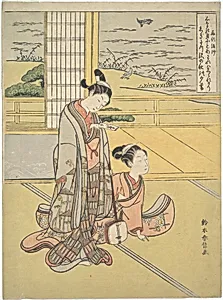
鈴木春信画 見立三夕 「西行法師」|A Young Man and Woman with a Shamisen; Monk Saigyō, from a series alluding to the Three Evening Poems (Sanseki waka)
ca. 1768
Medium
Woodblock print; ink and color on paper
Dimensions
11 1/6 x 8 1/4 in. (28.4 x 21 cm) medium-size block (chu-ban)
Classification
Prints
Culture & Period
Japan · Edo period (1615–1868)
Department
Asian Art
Museum
Metropolitan Museum of Art, New York, NY
Credit
Henry L. Phillips Collection, Bequest of Henry L. Phillips, 1939
Accession Number
JP2772
Rights
Public Domain
Tags
Art Historical Context
Suzuki Harunobu's *A Young Man and Woman with a Shamisen; Saigyō, from a series alluding to the Evening Poems (Sanse waka)* (ca. 1768) is a delightful example of Edo-period ukiyo woodblock printing. Harunobu, a master, pioneered full-color nishiki-e prints around 1765, transforming the "pictures of the floating world" with vibrant inks layered on paper. This chu-ban format—compact at about 11 x 8 inches—was perfect for affordable, intimate viewing in urban Japan, capturing the pleasures of everyday life amid the bustling culture of 18th-century Edo (modern Tokyo). The print playfully reimagines a famous waka poem by the wandering monk-poet Saigyō (1118–1190), part of the celebrated "Three Evening Poems" trio also featuring Ariwara no Narihira and Ono no Komachi. In Harunobu's *mitate* (parodic allusion) style, Saigyō appears as a stylish young man tuning a shamisen alongside a graceful woman, evoking themes of love, music, and fleeting romance rather than monastic austerity. Such clever literary references blended high poetry with popular entertainment, appealing to educated pleasure-seekers in teahouses and brothels. This Henry L. Phillips bequest at the Metropolitan Museum of Art showcases Harunobu's technical brilliance: precise woodblock carving allowed subtle color gradients and textures, making the scene glow with life. It's a window into Japan's poetic soul, where ancient verse danced with modern desire.
About the Artist
Suzuki Harunobu · 1725–1770
Suzuki Harunobu (c. 1725-1770) was a Japanese ukiyo-e artist who revolutionized woodblock printing by developing nishiki-e—full-color prints using multiple woodblocks—in 1765. Before Harunobu, Japanese prints were limited to two or three colors; his innovation unleashed the entire artist's palette, transforming ukiyo-e into the vibrant art form that would later captivate Western artists from Manet...