
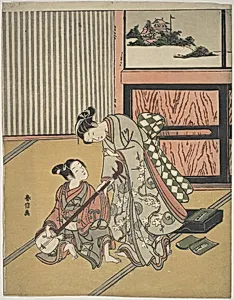
The Music Lesson
Medium
Woodblock print; ink and color on paper
Dimensions
H. 10 3/4 in. (27.3 cm); W. 8 7/16 in. (21.4 cm)
Classification
Prints
Culture & Period
Japan · Edo period (1615–1868)
Department
Asian Art
Museum
Metropolitan Museum of Art, New York, NY
Credit
H. O. Havemeyer Collection, Bequest of Mrs. H. O. Havemeyer, 1929
Accession Number
JP1650
Rights
Public Domain
Tags
Art Historical Context
Suzuki Harunobu's *The Music Lesson* is a delicate woodblock print from Japan's Edo period (16151868), capturing an intimate moment of feminine refinement. Created in the ukiyo-e tradition—"pictures of the floating world"—this work exemplifies Harunobu's mastery of bijin-ga, or images of beautiful women, often depicting elegant daily life. Though the exact date is unknown, Harunobu pioneered full-color nishiki-e around the 1760s,izing Japanese printmaking with vibrant inks layered on paper through intricate woodblock carving. Measuring just 10 3/4 by 8 7/16 inches, the print's intimate scale invites close viewing, revealing subtle gradations of color and fine lines that convey texture in fabrics and expressions of quiet concentration. Likely portraying a young woman receiving instruction on a traditional instrument like the shamisen or koto—hinted by the tags—this scene reflects Edo-era ideals of geisha culture and women's artistic education, blending sensuality with cultural poise. Housed in the Metropolitan Museum of Art's Asian Art Department as part of the H.O. Havemeyer Collection (1929), *The Music Lesson* offers a window into 18th-century Japan's thriving print culture, where affordable art democratized beauty for urban dwellers. Harunobu's innovative techniques not only influenced later masters like Utamaro but also bridged East and West, enchanting global collectors.
About the Artist
Suzuki Harunobu · 1725–1770
Suzuki Harunobu (c. 1725-1770) was a Japanese ukiyo-e artist who revolutionized woodblock printing by developing nishiki-e—full-color prints using multiple woodblocks—in 1765. Before Harunobu, Japanese prints were limited to two or three colors; his innovation unleashed the entire artist's palette, transforming ukiyo-e into the vibrant art form that would later captivate Western artists from Manet...