
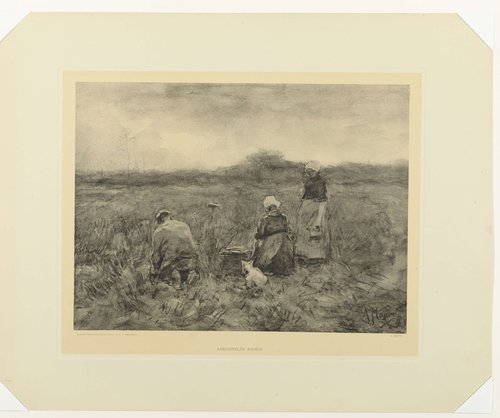
Aardappelen rooien
1903 - 1920
Medium
collotype
Dimensions
434; 324
Rights
Public Domain
About this artwork
onderschrift, recto linksonder, gedrukt: ‘Rijksmuseum Amsterdam (Coll. J.C.J. Drucker.)’
Art Historical Context
**Aardappelen Rooien (Digging Potatoes)** This evocative collotype print, titled *Aardappelen Rooien*, captures a timeless scene of rural Dutch life: laborers harvesting potatoes under expansive skies. Produced by the Stoomsteendrukkerij Senefelder, a Amsterdam-based steam lithographic press active in the early 20th century, the work dates from 1903 to 1920. Measuring 324 mm high by 434 mm wide, it bears a printed inscription on the lower left recto: "Rijksmuseum Amsterdam (Coll. J.C.J. Drucker.)," linking it to the prestigious collection of J.C.J. Drucker now housed at the Rijksmuseum. Collotype, a photomechanical technique perfected in the late 19th century, allowed for stunningly precise reproductions of photographs or paintings, rivaling original artworks in tonal depth and detail. Senefelder's firm specialized in such high-fidelity prints, making fine art accessible beyond elite circles. This medium flourished during the Netherlands' Belle Époque, bridging traditional lithography—pioneered by Alois Senefelder himself—with emerging photography. Potato farming was central to Dutch agriculture and culture, symbolizing sustenance and seasonal labor amid rapid industrialization. As part of the Rijksmuseum's holdings, this print offers a window into everyday heritage, preserving a snapshot of agrarian resilience for modern visitors.