
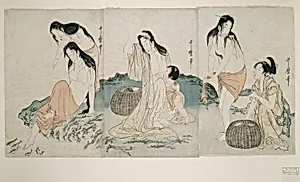
Abalone Divers
c. 1797/98
Medium
Color woodblock prints; oban triptych
Dimensions
38.3 × 75.1 cm (15 1/8 × 29 5/8 in.)
Classification
woodblock print
Department
Arts of Asia
Museum
Art Institute of Chicago
Accession Number
44659
Rights
Public Domain
Art Historical Context
Kitagawa Utamaro’s *Abalone Divers* (c. 1797/98) captures a striking scene of women at work along the seashore. Created as a color woodblock oban triptych, the three panels join to form a sweeping composition nearly thirty inches wide. Utamaro, celebrated for his sensitive portrayals of women, here turns his attention from the fashionable beauties of Edo’s pleasure quarters to the hardy ama divers who harvested abalone and other shellfish. In late-eighteenth-century Japan, ukiyo-e prints like this one offered affordable, colorful images of contemporary life to a broad audience. The triptych format allowed artists to present expansive, almost cinematic views while still fitting comfortably on a collector’s screen or wall. Utamaro’s elegant line work and subtle color gradations highlight both the physical grace and the communal effort of the divers, blending observation with idealization. Today the print invites viewers to consider the varied roles women played in Edo-period society and the remarkable technical sophistication of Japanese woodblock printing, which could reproduce delicate effects of water, fabric, and skin with remarkable economy and beauty.
About the Artist
Kitagawa Utamaro · 1753–1806
Kitagawa Utamaro (c. 1753-1806) was one of the most celebrated masters of ukiyo-e woodblock printing, revolutionizing the art of bijin-ga (pictures of beautiful women) during Japan's Edo period. Born Kitagawa Ichitaro, his early life remains shrouded in mystery, with conflicting accounts placing his birth in Kyoto, Osaka, Yoshiwara in Edo (modern Tokyo), or Kawagoe in Musashi Province. Under the t...