
Abâzîz, Intérieure d'un Village Arabe
1851–52
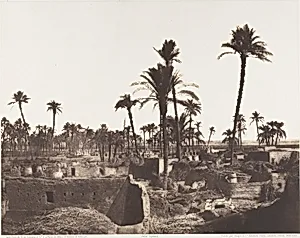
Medium
Salted paper print from paper negative
Dimensions
Image: 23.6 x 30.3 cm (9 5/16 x 11 15/16 in.) Mount: 39.7 x 51.7 cm (15 5/8 x 20 3/8 in.)
Classification
Photographs
Department
Photographs
Museum
Metropolitan Museum of Art, New York, NY
Credit
Gilman Collection, Gift of The Howard Gilman Foundation, 2005
Accession Number
2005.100.696
Rights
Public Domain
Tags
Art Historical Context
Step into the sun-baked heart of 19th-century Egypt with Teynard's *Abâzîz, Intérieure d'un Village Ar* (1851–52), a salted paper print that captures the intimate textures of daily life in an Arab village. Teynard, a pioneering French photographer, joined the wave of European expeditions to the Middle East, documenting ancient wonders and vernacular architecture during his 1851–52 journey along the Nile. This image, from his acclaimed album *Œuvres diverses*, offers a rare glimpse into Abâzîz—a modest settlement where mud-brick homes and ruins blend seamlessly, evoking the timeless resilience of rural Egyptian life amid architectural decay. Printed from a paper negative using the calotype process, this medium yields a soft, luminous matte finish with rich tonal gradations that highlight intricate details like weathered walls, arched doorways, and shadowed interiors. At 23.6 x 30.3 cm, it's a modest size that belies its historical weight: one of the earliest photographic records of North African villages, bridging Orientalist fascination with ethnographic precision. Acquired through the Gilman Collection at The Metropolitan Museum of Art, it exemplifies how photography revolutionized visual documentation, preserving scenes that might otherwise fade into obscurity. Today, this print invites us to ponder cultural intersections—European curiosity meeting Arab vernacular beauty—reminding visitors of photography's power to humanize distant worlds.
About the Artist
Félix Teynard · 1817–1892
**Félix Teynard (1817–1892)** was a pioneering French photographer whose work captured the ancient wonders of Egypt and Nubia with unprecedented precision and artistry. Born on January 14, 1817, in Saint-Flour, he trained as a civil engineer in Grenoble, a hub of Egyptology that likely sparked his fascination with ancient architecture. Little is documented about his early life or formal photograph...