
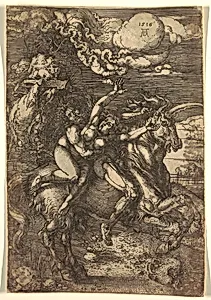
Abduction of Proserpine on a Unicorn
Medium
figures
Classification
figures
Department
Smithsonian Collection
Museum
Smithsonian American Art Museum
Credit
Bequest of George Campbell Cooper
Accession Number
1896-3-43
Rights
Public Domain
About this artwork
Pluto, riding a unicorn, galloping out of a swirl of sea-foam on the rocks at left, carries off the young Proserpine. Above, swirling clouds display the monogram of Dürer and date "1516".
Art Historical Context
Albrecht Dürer’s “Abduction of Proserpine on a Unicorn,” dated 1516, brings to life a vivid episode from classical mythology. The German Renaissance master shows Pluto, ruler of the underworld, riding a unicorn as he carries the young Proserpine away from the rocky shore. The pair gallops out of swirling sea-foam while turbulent clouds frame the scene, lending the composition a sense of urgent motion and drama. Dürer, celebrated for his precise printmaking and deep interest in both nature and myth, placed his famous monogram and the year within the clouds above. This signature not only authenticates the work but also draws the viewer’s eye upward, balancing the earthly struggle below with celestial movement. The unusual choice of a unicorn as Pluto’s mount blends ancient legend with medieval symbolism, creating an imaginative twist on a familiar story. Now in the Smithsonian American Art Museum, the piece reflects the early sixteenth-century fascination with classical tales reinterpreted through a Northern European lens. Its compact yet dynamic design invites viewers to explore how Dürer merged storytelling, symbolism, and technical skill into a single compelling image.