
Abraham and Isaac on the Way to Sacrifice, from Landscapes with Biblical and Mythological Scenes
1558
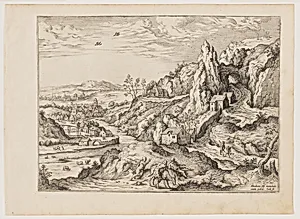
Medium
Etching on ivory laid paper
Dimensions
Plate: 22.6 × 31.3 cm (8 15/16 × 12 3/8 in.); sheet: 27.3 × 37.3 cm (10 3/4 × 14 11/16 in.)
Classification
etching
Department
Prints and Drawings
Museum
Art Institute of Chicago
Accession Number
268109
Rights
Public Domain
Art Historical Context
In the intricate etching *Abraham and Isaac on the to Sacrifice* (1558), Flemish printmaker Hieronymus Cock a pivotal moment from the Book of Genesis. Part of his series *Landscapes with and Mythological Scenes*, work depicts the solemn journey of Abraham and his son Isaac toward Mount Moriah, where Abraham believes he must sacrifice Isaac as a test of faith. Tiny figures of the pair wind through a vast, detailed landscape, emphasizing human vulnerability against nature's grandeur—a hallmark of 16th-century Northern Renaissance printmaking. Cock, a pioneering Antwerp publisher and engraver, masterfully employs etching on ivory laid paper, a fine medium that allowed for delicate lines and tonal depth. Measuring about 22.6 × 31.3 cm on the plate, this technique was innovative for its time, enabling mass reproduction of complex compositions originally designed by Cock or collaborators. Produced amid the Reformation's religious fervor, the print blends biblical narrative with emerging landscape traditions, influencing later artists like Pieter Bruegel the Elder, whom Cock published. Housed in the Art Institute of Chicago's Prints and Drawings Department, this piece highlights the cultural role of prints as affordable art, disseminating moral and artistic ideas across Europe. Visitors will appreciate its meticulous detail, inviting closer inspection of the interplay between faith, fate, and the sublime countryside.
About the Artist
Hieronymus Cock · 1510–1570
Hieronymus Cock, born Hieronymus Wellens de Cock in Antwerp in 1518, emerged from a distinguished artistic lineage; his father, Jan Wellens de Cock, and brother, Matthys Cock, were both accomplished painters and draftsmen. Admitted as a master painter to Antwerp's Guild of Saint Luke in 1545, he honed his skills in the vibrant Netherlandish tradition before traveling to Rome from 1546 to 1547, whe...