
Abraham Bloemaert
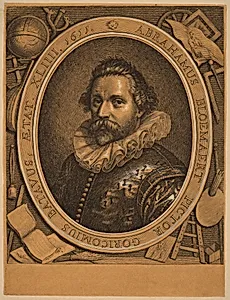
Medium
engraving with woodcut tone block in ochre on laid paper
Dimensions
plate: 20.4 x 15.5 cm (8 1/16 x 6 1/8 in.) sheet: 25.1 x 19.4 cm (9 7/8 x 7 5/8 in.)
Classification
Department
CG-E
Museum
National Gallery of Art, Washington, D.C.
Credit
Ailsa Mellon Bruce Fund
Accession Number
2002.8.2
Rights
Public Domain
Art Historical Context
This enchanting engraving, titled * Bloemaert*, captures the likeness of the renowned Dutch Golden Age painter Abraham Bloema (1566–1651), rendered by an anonymous Dutch artist around 1740 after an original portrait by Paulus Moreelse1571–1638). Bloemaert, a master of Mannerist and early Baroque styles, was celebrated for his landscapes, religious scenes, and innovative use of light and color, influencing generations of Utrecht artists. More, his contemporary and fellow native, specialized in portraits and history paintings, making this a poignant homage to artistic lineage preserved through printmaking. The medium—engraving combined with a woodcut tone block in warm ochre on laid paper—highlights 18th-century reproductive techniques. Engraving provided precise lines for facial details and attire, while the woodcut added subtle tonal depth and color, mimicking painting's richness on a modest scale (plate: 20.4 x 15.5 cm). Such hybrid methods made masterpieces accessible, democratizing art during the Enlightenment era when collecting prints flourished among Europe's cultured elite. Acquired through the Ailsa Mellon Bruce Fund for the National Gallery of Art's print collection (CG-E), this work bridges 17th-century genius with 18th-century craft, offering visitors a window into Dutch artistic heritage and the enduring power of portraiture to immortalize creativity.