
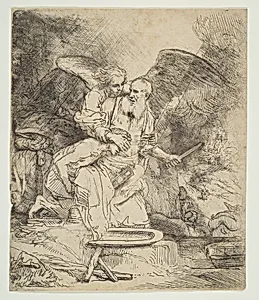
Abraham's Sacrifice
Medium
Etching and drypoint
Dimensions
sheet: 6 1/4 x 5 1/4 in. (15.8 x 13.3 cm)
Classification
Prints
Department
Drawings and Prints
Museum
Metropolitan Museum of Art, New York, NY
Credit
Gift of Henry Walters, 1917
Accession Number
17.37.201
Rights
Public Domain
Tags
Art Historical Context
In 1655, Rembrandt vanijn, the Dutch Baroque master renowned for his dramatic use of light and shadow, created *Abraham's Sacrifice*, a poignant etching and drypoint depicting the biblical story from Genesis where Abraham prepares to sacrifice his son Isaac, only to be halted by an angel. This intimate print, measuring just 6 1/4 x 5 1/4 inches, captures the tense moment with emotional intensity, showcasing Rembrandt's profound empathy for human struggle and intervention. Rembrandt's technical brilliance shines in his masterful etching—incising lines into a copper plate with acid—and drypoint, where a sharp tool burrs the plate's surface for rich, velvety textures and subtle tonal gradations. These techniques allowed for extraordinary depth in such a small format, making the work accessible yet monumental. Produced late in his career, it reflects his innovative printmaking, which influenced generations and elevated the medium to fine art status. Today, this gem resides in the Metropolitan Museum of Art's Drawings and Prints department, a 1917 gift from Henry Walters. It invites visitors to ponder themes of faith, obedience, and mercy, embodying Rembrandt's enduring legacy in interpreting sacred narratives with raw humanity.
About the Artist
Rembrandt (Rembrandt van Rijn) · 1606–1669
Rembrandt Harmenszoon van Rijn (1606–1669) stands as one of the greatest visual artists in the history of Western art and the most important Dutch painter of the 17th century. Born in Leiden to a prosperous miller's family, Rembrandt transformed painting through his revolutionary use of light and shadow, his psychological depth in portraiture, and his elevation of etching to a fine art. His approx...