
Abstract Design
1920-1926
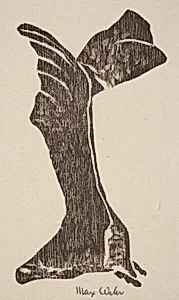
Medium
woodcut in black on laid paper
Dimensions
image (irregular): 11.5 × 6.25 cm (4 1/2 × 2 7/16 in.) sheet: 25.4 × 16.51 cm (10 × 6 1/2 in.)
Classification
Department
CG-W
Museum
National Gallery of Art, Washington, D.C.
Credit
Gift of Jack and Margrit Vanderryn
Accession Number
1997.128.24
Rights
Public Domain
Art Historical Context
Max Weber's *Abstract Design*, crafted between 1920 and1926, is a striking woodcut printed in black ink on laid paper. This print measures just 11.5 × 6.25 cm for the irregular image, set on a sheet of 25.4 × 16.51 cm, inviting close contemplation of its dynamic forms. As a gift to the National Gallery of Art from and Margrit Vander, it resides in the museum's print collection, showcasing Weber's mastery in translating bold abstraction into the tactile medium of relief printing. A pioneering modernist, Weber—born in Russia and active in New York—drew from Cubism, Synchromism, and African art influences to push American art toward abstraction in the post-World War I era. This period marked a shift from representation to pure form and rhythm, with Weber experimenting in prints to explore geometric patterns and interlocking shapes unburdened by narrative. His woodcuts, like this one, reflect the era's fascination with non-objective art, bridging European avant-garde with emerging U.S. modernism. The woodcut technique lends the design its crisp, incisive lines and subtle wood grain textures, hallmarks of a labor-intensive process where the artist carves away negative space from a block. On laid paper, with its characteristic chain lines, the print gains historical authenticity, evoking early 20th-century printmaking traditions while innovating boldly. Visitors, pause to trace the interlocking motifs—they pulse with the energy of a transformative artistic moment.
About the Artist
Max Weber · 1881–1961
Max Weber (1881–1961), born in Białystok in the Russian Empire (now Poland) to Orthodox Jewish parents, immigrated to Brooklyn, New York, at age ten with his family, joining his tailor father.) There, he pursued art studies at the Pratt Institute under Arthur Wesley Dow, an innovative teacher who emphasized expression and form over traditional narrative, drawing from Japanese art and Paul Gauguin....