
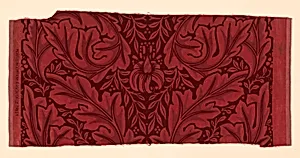
Acanthus
Design 1876, made 1877–1917
Medium
Cotton, twill weave with supplementary pile wefts forming cut "velveteen"; block printed
Dimensions
32.9 × 68.3 cm (12 7/8 × 26 7/8 in.)
Classification
textile
Department
Textiles
Museum
Art Institute of Chicago
Accession Number
52412
Rights
Public Domain
Art Historical Context
William Morris's *Acanthus*, designed in 1876 and produced 1877 and 1917, exemplifies the Arts and Crafts movement's revival of beauty in everyday design. A leading figure in this late-19th-century British movement, Morris rejected the mechanized ugliness of the Industrial Revolution, drawing inspiration from nature and medieval artistry to create textiles that brought artistry into homes. The acanthus leaf pattern, a classical motif symbolizing enduring life and immortality in ancient Greek and Roman decoration, is rendered here with Morris's signature flowing, organic lines, evoking lush foliage in vibrant hues. Crafted from cotton using a twill weave with supplementary pile wefts that form a luxurious cut "velveteen" surface, the fabric measures 32.9 × 68.3 cm. Its block-printed technique—stamping designs by hand with carved wooden blocks—highlights the movement's emphasis on skilled craftsmanship over mass production. This labor-intensive method ensured each piece had a unique, tactile quality, making *Acanthus* ideal for curtains, upholstery, or wall hangings. Housed in the Art Institute of Chicago's Textiles Department, this piece reflects Morris's enduring legacy through his firm, Morris & Co. It invites us to appreciate how design can transform ordinary spaces into havens of natural elegance and historical resonance.
About the Artist
William Morris · 1834–1896
William Morris (1834–1896) was a British designer, craftsman, writer, and socialist activist who became the most influential figure in the Arts and Crafts movement and one of the most important designers in British history. Born in Walthamstow, Essex, he studied at Oxford, where he formed a lifelong friendship with Edward Burne-Jones and came under the influence of John Ruskin's writings on art, l...