
Acrobat in Repose (Le saltimbanque au repos)
1905, published 1913
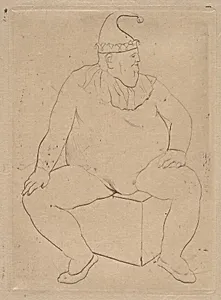
Medium
drypoint on laid Japanese paper
Dimensions
plate: 12 x 8.7 cm (4 3/4 x 3 7/16 in.) sheet: 48 x 33.3 cm (18 7/8 x 13 1/8 in.)
Classification
Department
CG-W
Museum
National Gallery of Art, Washington, D.C.
Credit
Rosenwald Collection
Accession Number
1952.8.281
Rights
Public Domain
Art Historical Context
Pablo Picasso’s *Acrobat in Repose* (1905) offers a quiet glimpse into the world of circus performers that fascinated the artist during his Period. Created when Picasso was just twenty-four, the drypoint shows a saltimbanque resting, his body relaxed yet alert. These itinerant entertainers, often seen as outsiders on the fringes of society, became poignant symbols for Picasso of the artist’s own struggles and resilience. The choice of drypoint on laid Japanese paper lends the image a soft, velvety texture. In this intaglio technique, the artist scratches directly into the copper plate, raising a burr that holds ink and produces delicate, feathery lines. Printed on fine Japanese paper, the result feels intimate and luminous, inviting viewers to share the acrobat’s moment of stillness. Although created in 1905, the print was not published until 1913, allowing Picasso’s early exploration of circus life to reach a wider audience. Now in the National Gallery of Art’s Rosenwald Collection, the work remains a tender testament to Picasso’s lifelong interest in human vulnerability and the poetry of everyday gestures.
About the Artist
Pablo Picasso · 1881–1973
Pablo Picasso (1881–1973), born Pablo Diego José Francisco de Paula Juan Nepomuceno María de los Remedios Cipriano de la Santísima Trinidad Ruiz y Picasso in Málaga, Spain, was the son of José Ruiz Blasco, a painter and art professor who served as his first teacher. From age seven, Picasso trained under his father in figure drawing and oil painting, mastering naturalistic techniques by copying mas...