
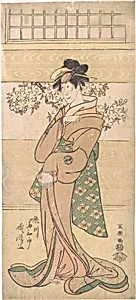
Actor Segawa Tomisaburo II as the Geisha Asaka
1794–95
Medium
One sheet of a pentaptych of woodblock prints; ink and color on paper
Dimensions
12 7/8 x 5 3/4 in. (32.7 x 14.6 cm)
Classification
Prints
Culture & Period
Japan · Edo period (1615–1868)
Department
Asian Art
Museum
Metropolitan Museum of Art, New York, NY
Credit
Harris Brisbane Dick Fund and Rogers Fund, 1949
Accession Number
JP3130
Rights
Public Domain
Tags
Art Historical Context
In the vibrant world of Edo-period Japan (1615–1868), Tōshūsai Sharaku captured the theatrical intensity of kabuki actors like no other. This striking woodblock print from 1794–95 the renowned onnagata (female impersonator) Seg Tomisaburō II as the geisha Asaka. As one sheet from a rare pentaptych—a five-panel composition—this intimate portrait (12 7/8 x 5 3/4 in.) showcases Sharaku's signature style: oversized heads, piercing gazes, and exaggerated features that pierce the soul, revealing the actor's raw emotion beneath the makeup and costume. Sharaku, a mysterious artist active for just two years, produced about 150 yakusha-e (actor prints) that revolutionized ukiyo-e, the "pictures of the floating world" genre celebrating urban pleasures like theater. His bold lines, vibrant inks, and colors on paper—affordable and reproducible via woodblock—made high art accessible to commoners. This piece highlights kabuki's allure, where men like Segawa masterfully embodied women, blurring gender lines in a male-dominated stage tradition. Housed in the Metropolitan Museum of Art's Asian Art Department (Harris Brisbane Dick Fund and Rogers Fund, 1949), it invites us to ponder performance's power: a frozen moment of artistry that bridged entertainment and cultural iconography.
About the Artist
Tōshūsai Sharaku · 1794–1795
Tōshūsai Sharaku stands as one of the most enigmatic figures in Japanese art history, a ukiyo-e printmaker whose brilliant career blazed for just ten months from the summer of 1794 to early spring 1795. Active exclusively in Edo (modern Tokyo), he produced approximately 150 woodblock prints and sketches, primarily yakusha-e—intimate portraits of kabuki actors captured mid-performance. Published by...