
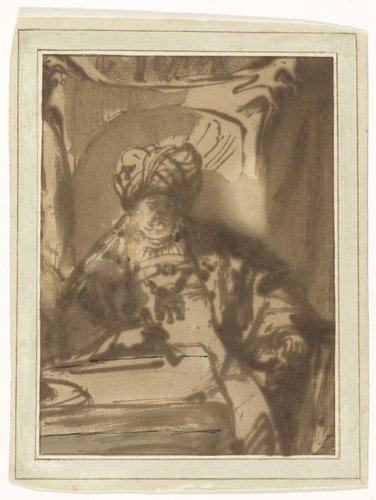
Actor Willem Bartholsz Ruyter as King Ahasuerus on his Throne
c. 1635 - c. 1640
Medium
pen and brown ink, with brown wash and opaque white, on paper toned with a light brown wash; later additions in pen and black ink; framing line in brown ink
Dimensions
177; 131
Rights
Public Domain
About this artwork
pen and brown ink, with brown wash and opaque white, on paper toned with a light brown wash; later additions in pen and black ink; framing line in brown ink
Art Historical Context
In the heart of the Dutch Golden Age, Rembrandt vanijn crafted this captivating drawing 1635–1640, portraying actor Willem Bartholsz Ruyter as the biblical Ahasuerus from Book of Esther. Seated regally on his throne, figure embodies the Persian monarch's grandeur, blending theatrical flair with historical drama. Rembrandt, renowned for his Baroque mastery of light and emotion, often sketched actors in costume, capturing the vibrancy of Amsterdam's lively theater scene and his fascination with biblical narratives. Executed in pen and brown ink with brown wash and opaque white on lightly toned paper, the work showcases Rembrandt's innovative drawing techniques. The toned ground enhances chiaroscuro effects—deep shadows contrasting luminous highlights—creating a sense of volume and immediacy on the small sheet (177 × 131 mm). Later additions in black ink and a framing line suggest ongoing refinements, reflecting the artist's iterative process. This intimate study highlights Rembrandt's genius in monochrome media, bridging portraiture and history painting. It offers visitors a window into 17th-century Dutch culture, where art, theater, and scripture intertwined, inviting us to ponder the king's stern gaze and the actor's poised performance.
About the Artist
Rembrandt van Rijn · 1606–1669
Rembrandt Harmenszoon van Rijn (1606–1669) stands as one of the greatest visual artists in the history of Western art and the most important Dutch painter of the 17th century. Born in Leiden to a prosperous miller's family, Rembrandt transformed painting through his revolutionary use of light and shadow, his psychological depth in portraiture, and his elevation of etching to a fine art. His approx...