
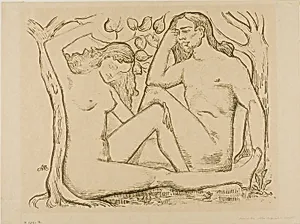
Adam and Eve
Medium
Zincograph in black on buff wove paper
Dimensions
Plate: 26 × 32.4 cm (10 1/4 × 12 13/16 in.); Sheet: 28.4 × 38 cm (11 3/16 × 15 in.)
Classification
zincograph
Department
Prints and Drawings
Museum
Art Institute of Chicago
Accession Number
110716
Rights
Public Domain
Art Historical Context
In 1895, French artist Aristide Maillol created *Adam and Eve*, a striking zincograph printed in black ink on buff wove paper. This intimate print, measuring about 10¼ × 12⅞ inches on the plate, captures the biblical figures in a moment of timeless human vulnerability, reflecting Maillol's early fascination with the nude form and mythological themes. Housed in the Art Institute of Chicago's Prints and Drawings Department, it exemplifies the artist's shift from painting and tapestry design toward masterful printmaking during the fin-de-siècle era. Zincography, a lithographic technique using zinc plates instead of traditional stones, allowed Maillol to achieve subtle tonal gradations and fluid lines, mimicking the softness of sculpture—foreshadowing his later fame as a monumental sculptor of voluptuous female figures. Popularized in the late 19th century for its affordability and precision, this medium democratized art, bringing Symbolist-inspired visions of paradise and primal innocence to wider audiences amid France's artistic ferment. *Adam and Eve* holds cultural resonance as a meditation on humanity's origins, blending classical harmony with emerging modernist sensibilities. Maillol's delicate handling invites viewers to ponder the interplay of light, shadow, and sensuality, making this print a gem for those exploring the roots of 20th-century sculpture.