
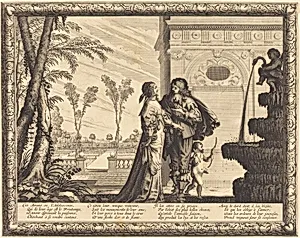
Adolescence
1636
Medium
etching and engraving on laid paper
Dimensions
sheet (trimmed within platemark): 25.6 × 32.4 cm (10 1/16 × 12 3/4 in.)
Classification
Department
CG-E
Museum
National Gallery of Art, Washington, D.C.
Credit
Rosenwald Collection
Accession Number
1943.3.2094
Rights
Public Domain
Art Historical Context
**Adolescence** (1636) by Abrahamosse is a captivating etching and engraving on paper, measuring 25.6 × 32.4 cm. Housed in the National Gallery of Art Rosenwald Collection, this print exemplifies Bosse's mastery during France's Baroque era under Louis XIII. As a leading 17th-century French print, Bosse pioneered etching techniques, blending them with precise engraving to create detailed, expressive images. His work often captured everyday life, social customs, and moral themes, making art accessible through affordable reproductions. The title *Adolescence* evokes the transitional phase of youth, likely portraying a young figure in a moment of growth or societal expectation—a common motif in period genre scenes. Etching allowed Bosse's fluid, spontaneous lines, while engraving added refined textures, showcasing his innovative approach that influenced generations. Laid paper, with its visible chain lines, was standard for fine prints, ensuring durability and authenticity. Bosse's prints held cultural weight, disseminating fashion, manners, and humanism across Europe. This piece invites visitors to ponder youth's universal trials amid 1630s opulence, a testament to printmaking's role in democratizing art. (178 words)
About the Artist
Abraham Bosse · 1602–1676
Abraham Bosse (1604–1676) was a French printmaker and theorist whose approximately 1,600 etchings provide an unparalleled visual record of 17th-century French life. Born to Huguenot parents in Tours, he trained in Paris under Melchior Tavernier and became a devoted follower of Jacques Callot's technical innovations. Bosse's meticulous etchings depicted subjects ranging from daily life and fashion ...