
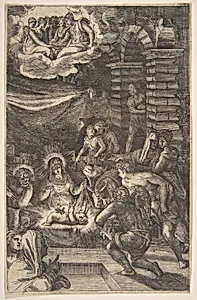
Adoration
ca. 1550–65
Medium
Etching with drypoint and some engraving
Dimensions
Sheet: 9 1/4 × 5 15/16 in. (23.5 × 15.1 cm)
Classification
Prints
Department
Drawings and Prints
Museum
Metropolitan Museum of Art, New York, NY
Credit
The Elisha Whittelsey Collection, The Elisha Whittelsey Fund, 1966
Accession Number
66.613.29
Rights
Public Domain
Tags
Art Historical Context
Giulio Bonasone's *Adoration*, created around 1550–65, captures the biblical scene of the Adoration of the Shepherds, a timeless moment from the Nativity story where humble shepherds pay homage to the Christ child. As a leading Italian printmaker from Bologna, Bonasone was renowned for his intricate reproductive engravings after masters like Raphael and Michelangelo, bridging the High Renaissance and Mannerist styles. This work exemplifies his skill in translating grand religious narratives into accessible prints, making sacred art available to a wider audience during the Catholic Counter-Reformation era. The medium—etching combined with drypoint and some engraving—is a highlight of technical innovation. Etching, using acid to bite lines into a metal plate, allowed for fluid, spontaneous marks, while drypoint's burr created velvety textures for soft shadows and textures in the figures' drapery. Engraving added precise details, enhancing the composition's depth on the modest 9¼ × 5⅞-inch sheet. These techniques marked a shift toward more expressive printmaking in 16th-century Italy, rivaling painting in emotional impact. Housed in the Metropolitan Museum of Art's Drawings and Prints department, this piece from The Elisha Whittelsey Collection reflects the era's booming print trade, which spread devotional imagery across Europe. Visitors will appreciate its delicate linework and intimate scale, inviting quiet contemplation of faith and humility.
About the Artist
Giulio Bonasone · 1500–1600
Comment on works: History; Mythology