
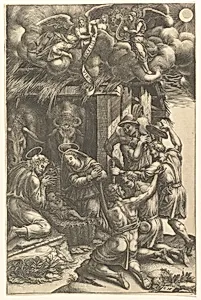
The Adoration of the Shepherds
late 1570s
Medium
Engraving
Dimensions
sheet: 10 11/16 x 7 1/16 in. (27.2 x 17.9 cm) borderline
Classification
Prints
Department
Drawings and Prints
Museum
Metropolitan Museum of Art, New York, NY
Credit
Harris Brisbane Dick Fund, 1953
Accession Number
53.600.992
Rights
Public Domain
Tags
Art Historical Context
**The Adoration of thes**, an exquisite engraving by the Italian master Giorgio Ghisi from the late 1570s, captures a timeless biblical moment from the Gospel of Luke., humble shepherds gather in awe around the infant Jesus, cradled by the Virgin Mary with angels hovering above in celestial splendor. Measuring 10 11/16 x 7 1/16 inches, this intimate print invites viewers into the sacred Nativity scene, blending reverence with human warmth. Now housed in the Metropolitan Museum of Art's Drawings and Prints department, entered the collection via the Harris Brisbane Dick Fund in 1953. Ghisi, a leading engraver of the Mannerist era active in Italy and the Netherlands, excelled in transforming paintings into intricate prints, making high art accessible beyond elite patrons. Engraving, a meticulous intaglio technique where lines are incised into a metal plate and inked under pressure, allowed for precise detailing and tonal depth—perfect for conveying the ethereal glow of divine light and the textured robes of the figures. This medium flourished during the Renaissance and Counter-Reformation, spreading devotional imagery far and wide. What makes Ghisi's work enduring is its artistic finesse: fine lines evoke movement and emotion, drawing the eye from the shepherds' rugged faces to the Madonna's serene gaze. A testament to 16th-century printmaking's cultural power, it reminds us how art bridged faith and everyday life, inspiring pilgrims and collectors alike.
About the Artist
Giorgio Ghisi · 1520–1582
Giorgio Ghisi (c. 1520–1582) was one of the most accomplished engravers of the Italian Renaissance, renowned for translating the monumental compositions of Raphael, Giulio Romano, and Michelangelo into the exacting medium of the burin. Born in Mantua, he trained in an environment shaped by the legacy of Giulio Romano's decoration of the Palazzo del Te, and the grandeur of that Mannerist tradition ...