
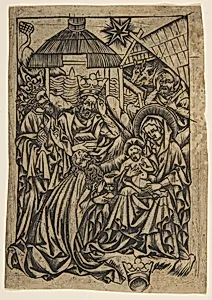
Adoration of the Magi
15th century
Medium
Woodcut
Dimensions
sheet: 4 7/8 x 3 1/2 in. (12.4 x 8.9 cm)
Classification
Prints
Department
Drawings and Prints
Museum
Metropolitan Museum of Art, New York, NY
Credit
Gift of Felix M. Warburg and his family, 1941
Accession Number
41.1.218
Rights
Public Domain
Tags
Art Historical Context
This delicate 15th-century German woodcut, *Adoration of the Magi captures a timeless biblical scene: the Three Wise Men presenting gifts to the infant Jesus, Mary, and Joseph. Created anonymously during a pivotal era when printmaking revolutionized art accessibility, this small print (just 4 7/8 x 3 1/2 inches) exemplifies early woodcut techniques. Carved into wood blocks and inked for multiple impressions, such prints were inexpensive to produce, allowing religious imagery to reach beyond elite patrons into homes and churches across Europe. In late medieval Germany, woodcuts like this flourished amid the Gothic tradition, blending intricate line work with devotional fervor. The *Adoration of the Magi* theme held profound cultural importance, symbolizing faith, kingship, and the universality of Christ's birth—resonating especially during Epiphany celebrations. Its modest scale suggests it served as a personal prayer aid or broadsheet, democratizing sacred art just before the Renaissance and Gutenberg's press transformed visual culture. Today, this rare survivor graces the Metropolitan Museum of Art's Drawings and Prints collection, a generous gift from Felix M. Warburg and his family in 1941. It invites us to marvel at how simple lines conveyed divine mystery to everyday believers five centuries ago.