
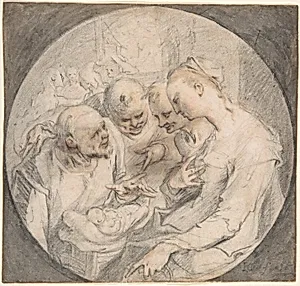
Adoration of the Shepherds
1600–1605
Medium
Black and red chalk with traces of yellow chalk
Dimensions
8-1/6 x 8-1/2 in. (20.7 x 21.6 cm)
Classification
Drawings
Department
Drawings and Prints
Museum
Metropolitan Museum of Art, New York, NY
Credit
The Elisha Whittelsey Collection, The Elisha Whittelsey Fund, 1999
Accession Number
1999.167
Rights
Public Domain
Tags
Art Historical Context
Created around 1600–1605, this intimate chalk drawing captures the tender biblical moment when shepherds visit the newborn Christ. Hendrick Goltzius, one of the most celebrated Dutch draftsmen of his day, worked on the sheet with his stepson and frequent collaborator Jacob Matham. Together they distilled the familiar Nativity story into a compact, emotionally direct composition that emphasizes the humanity of the holy figures. Executed in black and red chalk with faint touches of yellow, the drawing reveals the artists’ mastery of colored chalks, a technique that allowed them to model form and suggest warmth with remarkable economy. The red chalk lends a lifelike glow to the infant and surrounding figures, while the black lines provide structure and depth. Such drawings often served as preparatory studies for engravings, reflecting the close partnership between design and printmaking in the Goltzius workshop. Today the sheet offers visitors a rare glimpse into the creative process of two leading figures at the dawn of the Dutch Golden Age. Its sensitive handling of light and texture demonstrates why Goltzius and Matham were admired for transforming traditional religious subjects into works of quiet, naturalistic beauty.
About the Artist
Hendrick Goltzius|Jacob Matham · 1558–1617
Hendrick Goltzius (1558–1617) was the most celebrated engraver of the Northern Renaissance and a pivotal figure in Dutch Mannerism. Born near the German-Dutch border, Goltzius transformed printmaking into a virtuoso art form through his revolutionary 'swelling line' technique, where the burin was manipulated to create lines of varying thickness that produced unprecedented tonal effects and three-d...