
Aeneas and Achates Entering Dido's Palace in a Cloud
1624–63
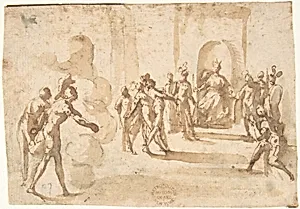
Medium
Pen and brown ink, brush and brown wash, over black chalk; framing lines in black chalk, and in pen and brown ink on mount
Dimensions
3-1/2 x 5-1/16 in. (8.9 x 12.9 cm)
Classification
Drawings
Department
Drawings and Prints
Museum
Metropolitan Museum of Art, New York, NY
Credit
Gift of Cornelius Vanderbilt, 1880
Accession Number
80.3.87
Rights
Public Domain
Tags
Art Historical Context
In this delicate drawing, *Aeneas and Achates Dido's Palace in Cloud*, Francesco Allegrini captures a pivotal moment from Virgil's epic poem *The Aeneid*. The Trojan hero Aeneas and his Achates, veiled in a divine cloud granted by Venus, approach Queen Dido's grand palace in Carthage. Created during Allegrini's lifetime (ca. 1624–63), the work reflects the 17th-century Italian fascination with classical mythology, blending drama and grandeur in the Baroque tradition. Allegrini, a draftsman from Gubbio associated with Roman and Bolognese circles, employs a masterful mixed-media technique: black chalk underdrawing provides subtle modeling, topped with precise pen lines, brown ink, and translucent brown wash for depth and atmosphere. At just 3½ x 5⅛ inches, this intimate sheet exemplifies preparatory sketches valued by collectors for their spontaneity and luminosity, evoking the ethereal mist of the mythological cloud. A treasured gift to the Metropolitan Museum of Art from Cornelius Vanderbilt in 1880, the drawing highlights the enduring appeal of Aeneas's fateful encounter with Dido—foreshadowing tragedy amid opulent splendor—and invites visitors to ponder how ancient tales inspired Renaissance and Baroque artists to explore heroism, fate, and divine intervention.
About the Artist
Francesco Allegrini · 1615–1679
Francesco Allegrini (c. 1615/20–after 1679), born likely in Rome to the painter Flaminio Allegrini from Cantiano near Gubbio, emerged from a family of artists that included his sister, Anna Angelica Allegrini. He trained under Giuseppe Cesari, known as the Cavalier d’Arpino, around 1638–40, before entering the studio of Pietro da Cortona, whose dynamic Baroque style profoundly shaped his own. Elec...