
Aeneas Carrying Anchises from Burning Troy
c. 1733
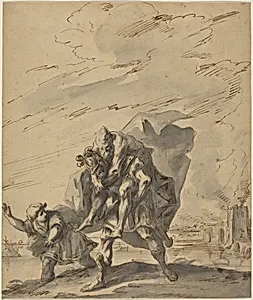
Medium
pen and brown ink with gray wash on tan laid paper
Dimensions
overall (approximate): 39.1 x 32.9 cm (15 3/8 x 12 15/16 in.)
Classification
Drawing
Department
CG-E
Museum
National Gallery of Art, Washington, D.C.
Credit
Ailsa Mellon Bruce Fund
Accession Number
1971.79.1
Rights
Public Domain
Art Historical Context
In the dramatic drawing *Aeneas Carrying Anch from Burning Troy* (c. 1733), Venetian artist Gaspare Diziani a pivotal moment from Virgil's epic *Aeneid*. Aeneas, the Trojan hero, flees the flaming ruins of Troy with his elderly father Anchises on his, embodying themes of piety, duty, and survival. Created with pen and brown ink heightened by gray wash on tan laid (39.1 x 32.9 cm), this work exemplifies Diziani's mastery as a Rococo draughtsman, blending fluid lines with subtle tonal modeling to evoke motion and emotion amid chaos. Diziani (1689–1767), a prominent figure in Venice's late Baroque-Rococo scene, drew inspiration from classical antiquity and contemporaries like Giambattista Tiepolo. The gray wash adds depth and atmospheric drama, simulating flickering firelight and shadows—techniques common in preparatory sketches for larger paintings or frescoes. This intimate medium allowed artists like Diziani to explore dynamic compositions quickly, making it a window into 18th-century studio practice. Acquired through the Ailsa Mellon Bruce Fund and housed in the National Gallery of Art's Department of Drawings (CG-E), this piece highlights the enduring cultural resonance of the Aeneid in European art. Visitors will appreciate its emotional intensity and Diziani's elegant handling of ink, a testament to Venice's rich drafting tradition.
About the Artist
Gaspare Diziani · 1689–1767
Comment on works: religious, mythology