
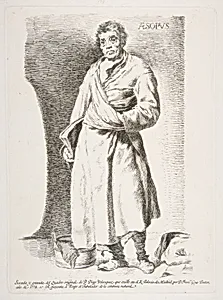
Aesop, after Velázquez
Medium
Etching
Dimensions
Plate: 11 5/8 × 8 7/16 in. (29.5 × 21.5 cm) Sheet: 16 1/8 × 11 5/16 in. (41 × 28.7 cm)
Classification
Prints
Department
Drawings and Prints
Museum
Metropolitan Museum of Art, New York, NY
Credit
Gift of Henry Walters, by exchange, 1931
Accession Number
31.31.16
Rights
Public Domain
Tags
Art Historical Context
This etching, titled *Aesop, after Velázquez*, captures Francisco de Goya y Lucientes' masterful 1778 homage to Diego Rodríguez de Silva y Velázquez's earlier Baroque portrait of the ancient Greek fabulist Aesop. Goya, a rising star in 18th-century Spain, meticulously reproduced Velázquez's depiction of the storyteller—often imagined as a wise, humbly dressed figure—in this intimate print. Housed in the Metropolitan Museum of Art's Drawings and Prints department, measures a modest plate size of 11 5/8 × 8 7/16 inches, gifted in 1931 through Henry Walters' exchange. Created via etching, a precise intaglio technique where acid bites into a metal plate to form intricate lines and textures, Goya emulated Velázquez's realism and psychological depth. This process allowed for rich tonal contrasts, bridging the painterly brushstrokes of the original oil with the graphic clarity of printmaking, making high art accessible to a broader audience. Goya's early series of etchings after Velázquez underscores his reverence for the Spanish master, influencing his own evolution from Rococo elegance toward Romantic intensity. For visitors, it offers a window into artistic lineage, celebrating Aesop's enduring legacy of moral tales while highlighting printmaking's role in preserving and democratizing masterpieces.
About the Artist
Velázquez (Diego Rodríguez de Silva y Velázquez)|Goya (Francisco de Goya y Lucientes) · 1599–1660
Diego Rodríguez de Silva y Velázquez, baptized on June 6, 1599, in Seville, Spain, emerged as one of the supreme masters of the Spanish Baroque. The eldest son of notary Juan Rodríguez de Silva and Jerónima Velázquez, he displayed prodigious talent early on. At around age 11 or 12, he apprenticed under Francisco Pacheco, the esteemed Sevillian painter, theorist, and writer whose studio functioned ...