
Africa
ca. 1670 - ca. 1700
Medium
ivory
Dimensions
9.8; 2; 3.4
Rights
Public Domain
About this artwork
ivory
Art Historical Context
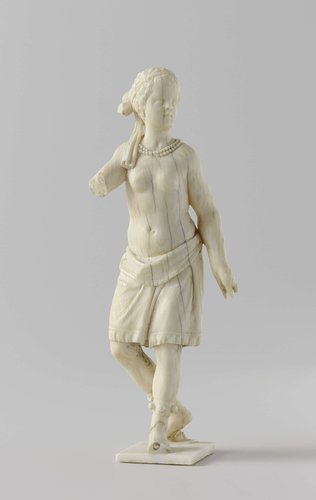
**Africa** by Joachim Henne (ca. 1670–ca. 1700) is a delicate ivory carving, measuring just 9.8 cm high, 3.4 cm wide, and 2 cm deep. Crafted during the late Baroque period, this diminutive sculpture exemplifies the era's fascination with intricate luxury objects, produced for affluent collectors across Europe. Ivory, prized for its smooth, luminous quality and fine carvability, allowed artists like Henne to achieve remarkable detail in compact forms, turning everyday materials into treasures. The title *Africa* suggests an allegorical personification of the continent, a popular motif in 17th- and 18th-century European art that reflected growing colonial explorations and exoticized views of the world. Henne's work likely captures symbolic attributes—perhaps evoking Africa's wildlife, landscapes, or peoples—through masterful low-relief techniques or three-dimensional modeling inherent to ivory sculpture. These small-scale pieces were often displayed on writing desks or as part of scholarly cabinets, blending artistry with encyclopedic curiosity. As a testament to the technical virtuosity of Baroque ivory carvers, *Africa* highlights the medium's cultural prestige, bridging fine art and craftsmanship. Though modest in size, its preservation offers a window into the opulent tastes of the time, inviting us to marvel at the patience required to shape such enduring elegance from elephant tusk.