
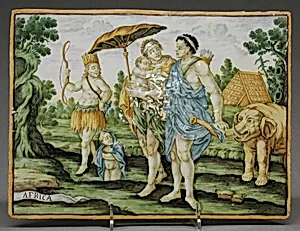
Africa (part of a set)
19th century
Medium
Earthenware
Dimensions
Overall: 9 3/8 × 12 5/16 in. (23.8 × 31.3 cm)
Classification
Ceramics-Pottery
Culture
Italian
Department
European Sculpture and Decorative Arts
Museum
Metropolitan Museum of Art, New York, NY
Credit
Gift of Estate of James Hazen Hyde, 1959
Accession Number
59.208.36
Rights
Public Domain
Tags
Art Historical Context
Nestled in the Metropolitan Museum of Art's European Sculpture and Decorative Arts, *Africa* is a captivating 19th-century Italian earthenware plaque, measuring 9 3/8 × 12 5/16 inches. Produced in the vibrant tradition of Italian ceramics—likely at a center like Castelli—this piece draws on designs attributed to Baroque masters Charles Le Brun and Frederick de Wit. As part of a larger set, it exemplifies the era's fascination with exoticism, blending meticulous modeling with colorful glazes typical of earthenware pottery. The scene bursts with life: children, men, and majestic elephants evoke the mysteries of the African continent, rendered in a playful yet detailed style that captures both human activity and wildlife. This reflects 19th-century Europe's Romantic interest in global exploration and "otherness," often idealized in decorative arts. Earthenware's accessibility made such grand themes attainable for elite homes, showcasing technical prowess in low-relief sculpting and vibrant pigmentation. A generous gift from the Estate of James Hazen Hyde in 1959, *Africa* highlights Italy's enduring ceramic legacy, bridging 17th-century engravings with 19th-century revivalism. Visitors will delight in its whimsical narrative, a window into how art transported distant worlds to intimate spaces.