
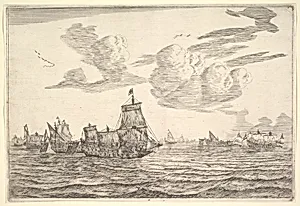
After the Battle
17th century
Medium
Etching; state II
Dimensions
sheet: 7 1/16 x 10 5/16 in. (18 x 26.2 cm)
Classification
Prints
Department
Drawings and Prints
Museum
Metropolitan Museum of Art, New York, NY
Credit
The Elisha Whittelsey Collection, The Elisha Whittelsey Fund, 1960
Accession Number
60.623.8(8)
Rights
Public Domain
Tags
Art Historical Context
**After the Battle** is a captivating 17th-century etching by Reinier Nooms, known Zeeman ("sailor"), a Dutch artist celebrated for his vivid marine scenes. Created during the Dutch Golden Age, this print (state II, measuring 7 1/16 x 10 5/16 inches) captures the somber aftermath of a naval clash, with ships likely strewn in disarray amid smoke and debris on the water. Nooms, who often drew from his seafaring experiences, masterfully conveys the chaos and human toll of battle through intricate lines, evoking the era's maritime drama. Etching, Nooms' preferred medium, allowed for precise, expressive detail in rendering ship rigging, waves, and distant horizons—hallmarks of Dutch printmaking innovation. As a second state, this impression may reflect the artist's refinements, enhancing tonal depth via selective biting of the copper plate with acid. Housed in the Metropolitan Museum of Art's Drawings and Prints department (Elisha Whittelsey Collection, 1960), it exemplifies how prints democratized art, bringing naval triumphs and tragedies to wider audiences. This work underscores the Netherlands' 17th-century seafaring dominance amid conflicts like the Anglo-Dutch Wars, blending technical prowess with poignant storytelling. A window into a world of wind, war, and resilience, it invites visitors to ponder the sea's unforgiving allure.
About the Artist
Reinier Nooms, called Zeeman · 1623–1664
Reinier Nooms, known as Zeeman ("sailor" in Dutch), was a prominent Dutch maritime painter, draftsman, and etcher of the Golden Age, born around 1623 or 1624 in Amsterdam and dying there in 1664 at about age 40. Before turning to art around 1643, he led a rough life as a professional seaman, which informed his unparalleled accuracy in depicting ships, ports, naval battles, and coastal scenes—knowl...