
After the Hurricane, Bahamas
1899
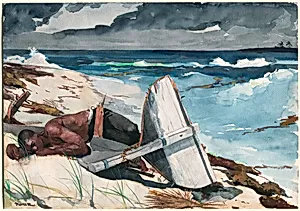
Medium
Transparent watercolor, with touches of opaque watercolor, rewetting, blotting and scraping, over graphite, on moderately thick, moderately textured (twill texture on verso), ivory wove paper
Dimensions
37.2 × 54.2 cm (14 11/16 × 21 3/8 in.)
Classification
watercolor
Department
Prints and Drawings
Museum
Art Institute of Chicago
Accession Number
16776
Rights
Public Domain
About this artwork
Revered as America’s master of watercolor, Winslow Homer did not begin working in the medium until the mature age of thirty-seven. As a watercolorist, Homer adapted his practice to the diverse locales he visited. His sojourns in the tropics took him to the Bahamas, Bermuda, Cuba, and various locations in Florida. In each new environment, the self-taught artist pushed the flexible medium in new directions as he applied his increasingly sophisticated understanding of color and light to a new set o...
Art Historical Context
Winslow Homer’s “After the Hurricane, Bahamas” captures the quiet aftermath of a tropical storm, a subject that preoccupied the artist during his later travels to the Caribbean. By 1899 Homer had already established himself as one of America’s foremost painters of the sea, shifting from Civil War illustrations to powerful marine scenes that explored humanity’s relationship with nature’s forces. This watercolor, created during one of his Bahamian visits, reflects his fascination with the dramatic skies and turbulent waters of the region. The work demonstrates Homer’s inventive approach to watercolor, a medium he helped elevate to the status of serious fine art. Layering transparent washes with selective opaque touches, he used rewetting, blotting, and scraping to achieve luminous skies and textured surfaces that evoke both the lingering moisture of the storm and the battered landscape below. Working over a graphite underdrawing on ivory wove paper, he balanced spontaneity with careful control, allowing the white of the sheet to play an active role in the composition. Housed in the Art Institute of Chicago’s Prints and Drawings collection, the painting stands as a vivid example of Homer’s late-career mastery. Its modest size belies the emotional weight of the scene, inviting viewers to sense both the destructive power and resilient beauty of the natural world.
About the Artist
Winslow Homer · 1836–1910
Winslow Homer (1836-1910) was one of America's greatest painters and a preeminent figure in 19th-century American art. Largely self-taught, Homer began his career as a commercial illustrator and Civil War correspondent for Harper's Weekly before becoming renowned for his powerful marine subjects and landscape paintings. His mastery of both oil and watercolor, combined with his uncompromising reali...