
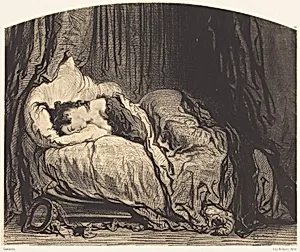
After the Pardon (Il lui sera beaucoup pardonne parce qu'elle a beaucoup danse)
1847/1856
Medium
lithograph
Classification
Department
CG-E
Museum
National Gallery of Art, Washington, D.C.
Credit
Rosenwald Collection
Accession Number
1943.3.4595
Rights
Public Domain
Art Historical Context
**After the Pardon (Il lui sera beaucoup pardonnée parce qu'elle a beaucoupé)** Created by French illustrator Paul Gavarni between 1847 and 1856, this lithograph captures the vibrant, satirical spirit of mid-19th-century Parisian. Gavarni, a master of Romantic caricature, often depicted the city's bohemianbelly—theaters, dancers, and courtesans—with sharp wit and empathy. The title, a playful twist on a biblical verse from Luke 7:47 ("Much is forgiven her because she hath loved much"), suggests a scene of redemption or indulgence, likely featuring a weary dancer reflecting on her passionate, performative existence amid the July Monarchy's social whirl. As a lithograph, the work showcases Gavarni's expertise in this revolutionary printing technique, invented in the late 18th century. It allowed artists to draw directly on stone with greasy crayon, producing rich tonal variations and fluid lines that could be reproduced affordably in large editions. This democratized art, spreading Gavarni's commentary on class, gender, and morality to a wide audience through journals like *Le Charivari*. Housed in the National Gallery of Art's Rosenwald Collection, it exemplifies how prints bridged fine art and popular culture. Gavarni's nuanced portrayals humanized marginalized figures, offering cultural insight into the era's fascination with spectacle and fleeting pleasures. A gem for visitors, it invites reflection on forgiveness, fame, and the dancer's enduring allure. (198 words)
About the Artist
Paul Gavarni · 1804–1866
Paul Gavarni, born Sulpice Guillaume Chevalier on January 13, 1804, in Paris to a cooper father from Burgundy and mother Marie-Monique Thiémet—whose brother, painter Guillaume Thiémet, served as his godfather—began his career far from the art world. As a youth, he worked in a machine factory and studied mechanical drawing at the Conservatoire des Arts et Métiers in 1818, followed by evening classe...